


Data defines an organisation’s ability to innovate safely. It is the most valuable asset a business has, with the ability to enhance operations, build the foundations for AI, and drive commercial success.
Every transaction, interaction, message and AI prompt generates data. We’re creating more data than we ever have done. With each touchpoint, more data is created and therefore needs cataloguing, storing, and managing. How on earth do we keep up with the 402 million terabytes of data that are created every day?
There’s someone we’d like you to meet…
What is Microsoft Purview?
Microsoft Purview is an all-in-one solution for data governance, security, risk and compliance, and enables data transformation that can fuel innovation. In 2026, Purview has expanded significantly to become Microsoft’s unified governance and AI‑risk management platform. The platform underpins safe adoption of Copilot and custom AI agents across organisations. It is made up of a wide range of features that allow for the management of data across on-premises systems, multi-cloud environments, and Software as a Service (SaaS) platforms.
Microsoft Purview’s most widely adopted and impactful features live directly inside the Microsoft 365 ecosystem. Native capabilities such as sensitivity labels, automatic data classification and Data Loss Prevention (DLP) apply protection consistently across Outlook, Teams, SharePoint, OneDrive and Windows endpoints. This ensures that Purview provides everyday, real‑world data security as well as visibility across the wider data estate.
With Purview, businesses can ensure that their data is correctly governed, its quality is managed, risks are mitigated, and that generative AI applications meet industry and legal regulatory requirements. Microsoft has explicitly positioned Purview as a core pillar of the Copilot Control System, the framework used to manage security for Copilot and AI agents.
What are the key components of Microsoft Purview?
Microsoft Purview is a collection of tools, all working together to provide a holistic approach to data governance, security and compliance.
Data Security Solutions
Purview provides a comprehensive range of data security solutions, including Microsoft Purview Data Security Posture Management, Data Loss Prevention, Information Protection, Insider Risk Management, Data Security Investigations and Copilot in Microsoft Purview. These tools are designed to identify and safeguard sensitive information, ensuring thorough data security throughout your organisation.
In addition, Purview provides protections for generative AI apps. It tracks AI activity, prevents data loss and ensures compliance with best practice.
Information Protection
Microsoft Purview’s Information Protection engine provides consistent and context‑aware security across the Microsoft 365 stack. Through sensitivity labels, encryption policies, data residency controls, and retention rules, organisations can protect data including AI‑generated content. These capabilities operate natively across all M365 applications, ensuring that users can collaborate freely while Purview handles protection quietly in the background.
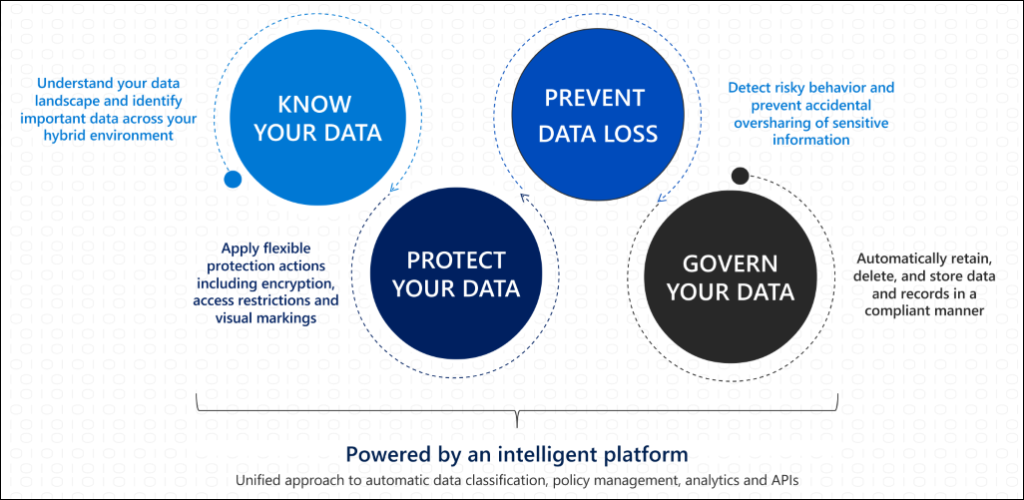
Data Loss Prevention (DLP)
Purview’s DLP capabilities allow organisations to detect and prevent the accidental or intentional sharing of sensitive information across Teams, SharePoint, Exchange, endpoints and AI tools. With policy‑level insights and automated remediation, organisations can reduce data leakage risk without disrupting user workflows. This M365‑embedded capability is one of the most widely adopted areas of Purview and plays a foundational role in securing operations.
Discover, prioritise and protect your data with our Purview DSPM & DLP Accelerator,
Data Governance Solutions
The platform features integrated data governance solutions that oversee data services across on-premises, multi-cloud, and SaaS environments – including Azure storage services, Power BI, SQL Server, Hive, Amazon S3, and others. Tools such as Microsoft Purview Data Catalogue, Data Estate Insights, Data Map, Data Policy, and Data Sharing empower organisations to effectively map, identify, manage, and secure their data.
Data Sharing and Policy
Purview facilitates secure data sharing both within and between organisations, while also allowing centralised management of data sharing relationships. The Data Policy app streamlines the management of data access across multiple sources, ensuring both security and compliance.
Data Insights
This is a vital tool for governance stakeholders, with a comprehensive overview of the data estate, offering actionable insights into governance gaps. It features metrics, reporting, and visualisation tools to track and improve data governance policies, ensuring effective resource allocation and adherence to regulatory requirements.
Data Catalogue
This is the central component of the Purview platforms. Effective data cataloguing allows users to discover and search for data assets across the business, accessing only the information they should be able to in line with a just-enough-access policy.
Data Map
This feature automates data discovery by scanning and classifying assets across your data estate, providing a holistic view of your data landscape. It serves as the foundation for data discovery and governance, facilitating easy and efficient management of enterprise data.
Additionally, Microsoft Purview Data Quality enables assessment and recommendations for improvement to data quality within business domains. It provides AI-driven insights to increase the reliability and confidence in the data found in the data catalogue, helping organisations to become AI ready.
Risk and Compliance Solutions
Microsoft Purview’s risk and compliance solutions help organisations manage compliance risks and meet regulatory requirements through a suite of tools. These include Microsoft Purview Audit for tracking user activities, Communication Compliance for monitoring communications, Compliance Manager for assessing compliance posture, Data Lifecycle Management for handling data from creation to disposal, and eDiscovery for managing electronically stored information relevant to legal cases. These tools ensure secure, compliant data handling throughout the data lifecycle.
Purview AI Hub
The Purview AI Hub provides a central workspace for monitoring, governing, and securing AI usage across your organisation. It offers visibility into how AI tools, such as Microsoft Copilot and third‑party generative AI services, access and process sensitive data, and enables you to set and enforce policies that minimise AI‑related data risks. The AI Hub helps organisations adopt AI responsibly while meeting emerging regulatory and compliance requirements.
By leveraging these seven capabilities, businesses can ensure their data is managed effectively, protected adequately, and utilised fully. Whether you are addressing regulatory compliance, improving data quality, or enabling secure data sharing, Microsoft Purview offers the tools and insights needed to transform your data governance strategy.
What are the core implications of Microsoft Purview?
We’ve covered what it does, but what effect does it have on your business? And especially why does it matter in 2026 more than ever?
Unified Data Governance
Microsoft Purview provides a centralised platform for managing data governance across the entire data estate. This unification simplifies the process of ensuring data quality, security, and compliance, eliminating data silos and reducing the complexities associated with managing disparate data sources.
Protecting Data in Transit
Sensitivity labels and DLP ensure that protection stays attached to data, whether it’s shared, copied, or surfaced by AI. Purview further strengthens this by continuously inspecting data paths across apps, devices and AI interactions. This ensures that sensitive information remains encrypted and governed even as it moves through multi‑cloud and hybrid environments.
AI‑Aware Governance
Purview applies controls not just to files, but to AI prompts, responses, and agent activity, helping prevent sensitive data leakage into generative AI tools. It also provides visibility into how AI models use and reference organisational data, offering audit trails, risk scoring and policy enforcement that align with emerging AI governance standards and regulatory expectations.
Better Collaboration and Data Sharing
Purview facilitates better collaboration by making it easier for teams to discover and understand data. The data catalogue and business glossary ensure that everyone in the organisation speaks the same data language, fostering a culture of data-driven decision-making and reaping the rewards that come with that.
How Microsoft Purview can benefit your industry
Purview isn’t just a toy for your IT team to play with. It’s a platform that will impact your entire organisation, shaping the way data is managed and moved in your teams, departments and geographies. No matter what industry you operate within, there’s a Purview use case for you.
Finance
Businesses operating within the UK’s financial services industry must comply with regulations such as the UK Sarbanes-Oxley Act, the Senior Managers and Certification Regime, and GDPR. Microsoft Purview helps FSI firms automate data discovery, classification, and lineage tracking, ensuring that all regulatory requirements are met. This automation not only reduces the risk of non-compliance, but also minimises the effort required for compliance reporting.
Healthcare
With the NHS being the world’s largest publicly funded healthcare service, imagine the amount of patient data, research data, test result data… this list is endless. It’s no doubt that cybersecurity and privacy is at the forefront of their business decisions. Purview allows healthcare providers to classify and protect patient data, ensuring compliance with GDPR and other healthcare regulations. Providing visibility into data access and usage, Purview helps prevent data breaches and ensures that patient information remains confidential, while still being able to use it to make critical decisions.
Manufacturing
The UK manufacturing industry is among the strongest in the world, bringing in £224 billion to the UK economy each year. Its complex data ecosystem means it stands to benefit hugely from Purview. The platform enables these companies to create a unified data governance framework, improving data quality and operational efficiency. With better data insights, manufacturers can optimise their production processes, reduce downtime, and enhance product quality.
Retail
Retailers rely on data to understand customer preferences, manage inventory, and optimise marketing strategies. Purview’s data cataloguing and business glossary make it easier for retail businesses to discover and analyse data, driving data-driven decision-making. By ensuring data accuracy and consistency, Purview helps retailers enhance customer experiences and improve business outcomes.
Non-Profits
While charities must comply with regulations such as, the Charity Governance Code, and the requirements set by the Charity Commission, they also rely heavily on their data to understand donor behaviour, optimise fundraising strategies, and measure the impact of their programs. Microsoft Purview plays a crucial code in helping charities manage these dual priorities. It does this by automating key compliance tasks like data discovery and classification, while ensuring that charities handle sensitive donor and beneficiary information securely. Automating these processes reduces the risk of data breaches, but also frees up valuable resources to focus on critical fundraising activities.
What next?
Further your Purview knowledge by listening to our on-demand webinar “Securing the AI Frontier with Microsoft Purview DSPM”
During this hour webinar we cover how to protect sensitive data as your teams adopt Copilot and Generative AI. You’ll hear from Microsoft’s Security & Compliance Solution Engineer Karim Fayad, who covered:
- Why traditional security models fall short for AI
- How the Microsoft Purview AI Hub gives you visibility of AI risk
- Preventing sensitive data leakage through AI prompts
- How sensitivity labels follow data through Copilot
- Using audit and risk trends for compliance and monitoring
- A practical deployment path for DSPM for AI
Whether you’re preparing for Copilot, responding to regulatory pressure, or simply want confidence that sensitive data isn’t being overshared, get in touch and we can help support your Microsoft Purview journey.
Sound good? Get in touch.
Since its introduction to the world late last year, Copilot has been a massive topic of discussion. Whether you’re all-in on Copilot changing the world and the way that we work, or if you’re more pessimistic and see it as a bit of a gimmick, it’s likely that you have an opinion on it.
Regardless of which way you’re swaying, there is one thing that no one can ignore… the cost. Copilot is expensive – there’s no two ways about it. But it is an investment worth making if you do so with due care and consideration. That requires making sure you are AI ready and having a tangible, measurable use case for its adoption.
To see if you’re in a position to make a success of Copilot, you’ll need to ask yourself a few questions. Don’t worry, this blog should help you answer them…
Who?
Who will benefit most from Copilot? It would be silly to throw all your eggs in one basket and bag a Copilot license for everyone in the business. Deployment must be strategic, so think about which teams and individuals need the help.
Identify who may be under-performing, or potentially those who have a lot of administrative work in their jobs. Management roles across the organisation stand to benefit, with it being reported that they save up to 30 per cent of their admin time with Copilot.
Roles that see their calendars stacked with meetings will also get the best out of Copilot. We’ve seen evidence of that at Cloud Direct, with heavy use of the transcript and recap functions in Teams – findings which are backed up by Microsoft research, which shows that ‘users were able to get caught up on a missed meeting nearly four times faster.’
Making sure you assign your licenses to the right people is incredibly important. It’s equally important that you keep track of this, and check in with those who are using Copilot and the value they’re extracting from it. Assigning a license to someone who ultimately doesn’t use it very much is throwing money down the drain every month, and licenses can easily be reallocated within the organisation.
What?
The next important step is identifying what it is going to be used for. Are your sales team tired of writing tedious follow up emails? Are project managers struggling with tracking projects? Are customer support stretched and need something to listen in and summarise common issues faced by customers?
Adopting Copilot with a clear vision of what it is going to help with means that you can leverage it more effectively, and get the biggest bang for your buck. Think about asking your teams what part of their job they wish could be done quicker, more efficiently, or eradicated altogether, so that you can plot your route before you set sail.
Where?
Let’s zoom out from the individuals in the who section, and focus on the where – specifically, where within your organisation Copilot will make the biggest splash. Think of the teams, departments or geographies that could benefit most from administrative automation, and get to know their challenges.
Let’s take a quick look at sales. Love them or loathe them, a salesperson’s time is critically important. The less time they spend on the menial, tiresome tasks, the more time they can spend generating revenue. “In sales, Copilot has helped sellers at more than 30,000 organisations, to enrich their customer interactions,” said Microsoft CEO Satya Nadella. So much for AI making things less human.
If you are looking at a wider rollout of Copilot, focusing on a single department is a sensible way to start. It’s a great way to test the waters and assess if your investment is going to be worthwhile. Discover which team will reap the biggest rewards, and work from there.
Why?
The next thing you have to ask yourself is why. Why are you looking to adopt Copilot in the first place? Not because your competitors are, not because it’s the word on everyone’s lips, not so that you can put your feet up and let AI replace you… push yourself, and make sure those reasons and use cases are valid, tangible and to the benefit of the business. Copilot is a shiny new toy that everyone seems to want to play with – Ally Financial, Coca-Cola and Rockwell Automation, to name but a few – but it doesn’t mean you should just whip out the cheque book straight away.
Your reasoning shouldn’t be just because those big companies or your competitors are doing it. A justifiable why is more important than just a why. If you are to take your time and use Copilot to actually address and tackle your specific challenges, then those competitors who are spending the money just to say they have it are the ones that will suffer in the long term.
AI is already finding its way into the hiring process, too. If you’re a company that can demonstrate its use of AI and how it will improve the work life of a potential hire, then you are going to be seen as a business that people want to work for. On the other hand, those who have just rushed to adopt the shiny new toy without a plan in place won’t make the same impression.
How?
We’ve saved the biggest question until, well, nearly the end. How are you going to get there? How are you going to prepare yourself, your team, and your organisation to adopt Copilot?
We’re getting more technical here, but setting out a roadmap for your Copilot adoption is critical. There’s a lot to consider, but we’ve broken the process down into seven simple steps that you can tick off, one by one, with each moving you closer to AI readiness.
- Step One: Migrating to the cloud
- Step Two: Optimising your cloud platform
- Step Three: Creating data strategy & fostering data culture
- Step Four: Securing and properly governing data in the cloud
- Step Five: Building specific use cases for data & AI tools
- Step Six: Gaining insights for cloud-based data with data analysis
- Step Seven: Implementing an AI strategy
There’s a lot to take in on this section – too much to cover in this blog post. If you are looking to learn more about how to become AI ready and prepare your organisation for Copilot adoption, then check out this webinar we did late last year.
When?
Finally, it comes to working out when you are going to adopt Copilot. You can’t rush into it, otherwise you’ll fall flat on your face, but drag your heels and you’ll be left in the dust of your competitors.
Successful adoption relies on the foundations you lay – it’s preparing your data, securing your perimeter and, perhaps most importantly, training your team. All of this needs to be done before your Copilot rollout, instead of scrabbling around for quick fixes once you’ve got the ball rolling.
Beyond adoption you also need to consider its use cases, and in which scenarios your team should look to lean on it. There’s also training to thing about scheduling in – Copilot is not as simple as all the fancy videos make it look, and it requires practice and training if you want to make sure you get the most out of all the available tools.
Making sure you train your team how to do this as you roll it out is important. You need to create a clear training plan that teaches your teams how to get the most out of Copilot –everyone knows how to ask ChatGPT to write a generic email or to rank their favourite footballers, but Copilot requires more from its users. Despite what is promised, you can’t simply ask it to do all your unwanted jobs for you. Your team need to become prompt engineers, and learn how to ask Copilot the right questions and give it the right commands to maximise its output. Without proper training, your team will be left with a glorified chatbot that is more of a hindrance than a help – and that’s a waste of their time, and your money.
…and what next?
Copilot’s release saw it become the world’s most exciting corporate toy, but it is so much more than that. It can unlock your business potential, freeing up your team’s time to spend on more innovative, creative, and meaningful tasks. It isn’t perfect (yet), and nor is it a worthwhile investment if you aren’t willing to do the work beforehand.
Luckily, there’s a team of experts on-hand that have been there and got the t-shirt – and you’re already here. Let’s talk about how we can get your organisation AI ready, and start making the most of Microsoft’s market-leading assistant.
AI has started a new gold rush in the world of technology. The global AI market was valued at $515 billion in 2023, and is projected to reach $2.74 trillion by 2032. It’s become the new talk of the town, and prospectors are looking to strike gold with quick and secure solutions that will accelerate their business innovation.
The world of IT may be mostly free of gunslingers and highwaymen, but AI can still be unpredictable and dangerous if it’s not approached with care and consideration. Rather than trusting the words of a cowboy or snake oil salesman, we’ve prepared six key questions that your company should ask itself before exploring IT’s new frontier.
Q1: Have you migrated to the cloud?
Migrating to the cloud is one of the first important steps when looking to adopt AI. These platforms are fueled by data, and cloud platforms like Microsoft Azure provide a great place to store, manage and secure that information. Azure provides a framework that includes tools, programs and content that help simplify the adoption of AI and other cloud-native practices.
Before you start this journey though, there are a few things you need to work out, like a coherent and justifiable business case for migrating. This is about asking;
- How much are you going to migrate?
- Is it financially viable to migrate now?
- Do the benefits outweigh the negatives?
- Have you looked into the resources already provided by Microsoft?
There are also funding opportunities – which can only be accessed by working with select partners – that would offset some of the costs of migrating and potentially unlock other opportunities and projects. This can help a lot with creating a compelling business case, and we’ll be coming back to this point a little later on.
If you have these things in place then perfect, you can get going with your migration. We’ve created a step-by-step migration strategy guide to help get you going, or this article provides a comprehensive outline for migrating on-premise data pipelines.
Already operating in Azure? Great – it’s time for the next question.
Q2: Are your costs under control?
The second question that you should be asking yourself constantly – with or without AI – is whether or not your costs are under control. According to a 2023 survey by Gartner, businesses are wasting more than a third of their cloud spend on average each year. That’s not just wasted cash, it’s wasted opportunity – money that could be funding your AI journey is going straight down the drain.
You might be wondering where on earth this wastage is. What’s it being spent on? While there isn’t a one-size-fits-all answer, data science publication TDS says “inefficiencies like idle infrastructure can waste significant amounts of data infrastructure investments.” One of the best ways to prevent such wastage is to run regular cost assessments that allow you to properly analyse which parts of your infrastructure are responsible for this over-investment, and what remedial action should be taken.
Another option could be switching your payment model. For example, if you are in an industry where your requirements will fluctuate, you might benefit more from a pay-as-you-go model that allows greater flexibility in scaling your workloads and means you only pay for what you use. Thus, allowing you to adapt to your requirements. Whereas industries that are a lot more stagnant and can easily plan for the amount of architecture that they would use, may benefit more from a reserved instance, as your long-term projects are far more predictable and plannable.
Q3: Have you optimised your cloud security and performance?
AI runs on data – you’re sick of us saying that, but we’ll keep beating the drum. If you want to get the most out of AI then you will need to ensure that it can access that data as efficiently as possible. Regularly running performance assessments on your cloud infrastructure will aid efficiency.
Optimisation will enable you to scale your resources, optimise and identify bottlenecks, and will improve the ability of your system to adapt to changes in its workloads. This will in turn make the process of adopting AI smoother and more straightforward, before the technology begins aiding the optimisation process in the long run.
Security is at the forefront of all things IT – and AI is no exception. As artificially intelligent platforms will often be working with larger loads of data and, particularly in some cases, extremely sensitive data, it is going to need watertight security. For example, in 2020 a company named Cense AI almost leaked 2.6 million medical records because “Cense AI was temporarily hosting it online before loading it into the company’s management system or an AI bot.” A major risk to take that should’ve been calculated and could’ve been avoided if the correct cloud security measures had been in place. If you are interested in learning more about this case then check it our here.
If you are want to know more about cloud security, we’ve also outlined six ways to stay secure in the cloud on The Learning Hub.
Q4: Are your custom business applications modernised?
Now that you’re on top of your costs and your performance, it’s time to start thinking about the applications that help you operate day in, day out. Outdated, monolithic applications are expensive and don’t offer the same benefits as they will do when run in Azure. Migrating them means you unlock greater security and scalability, and that the data from these applications is going to be easier to access for your AI model.
But the buck doesn’t stop with migration. Modernising your applications also requires a cultural shift in how your organisation approaches the management of them. This often presents itself as a DevOps methodology, which promotes greater group collaboration and efficiency when looking to adopt AI. It means sharing responsibilities and workloads, but it doesn’t come easily. It’s a shift in your processes, your approach, and your mentality – but you’re already looking to revolutionise your organization, so it’s the perfect time to adopt a DevOps approach.
Q5: Is your data accessible?
Oh look, we’re mentioning data again. It undoubtedly feels very repetitive, but it is the most important thing when it comes to adopting artificial intelligence. Data is the fuel that is needed for AI to function, so ensuring it has easy, unhindered access is vital.
Microsoft makes this easier with products like Azure Data Factory is a perfect solution for hybrid environments, enabling you to control, secure, govern and unlock data across both on-prem and cloud servers.
Even if you’re not looking to adopt AI right now, then keeping your data accurate and up to date is still an important practice. As Jordan Kanter at Perficient points out: “The consequences of using bad data extend beyond immediate operational challenges…”, before explaining that poor data quality costs the US healthcare system $210 billion per year.
Q6: Do you gain insights from your data?
You’ve done the hard work. You’ve scrubbed your data, made sure it’s on a modern data platform, and that your analysts and AI have the access they need… so what’s next? You need to know how to use the tools you now have at your fingertips – it’s no use having all that data if it’s just going to sit there.
Picture your business as a house. Each department is a different room – with its own boundaries and confinements – and your data is your wiring. It flows from room to room, reaching every corner of the house and being just as critical in each and every area. Some rooms use it for lighting, others to run washing machines, a third to power a television. Each room has its own uses for the electricity, but it is the same utility that enables all of them.
Now, if users in each room were forced to hardwire their appliances into the wall, we’d be running into problems pretty quickly. Thankfully, plug sockets give us an easy-to-use, ultra-accessible interface to benefit from our wiring system. So, we need a data equivalent.
While there are Microsoft products that solve these issues – be it PowerBI, Synapse or Fabric – your teams will also require training to fully understand the tools you’ve put at their fingertips. Then, and only then, will your entire business be able to put your datasets to work and start making data-driven decisions that truly empower your whole organisation.
Right, it’s time to implement an AI strategy…
Once you’re happy with your answers to these six questions, it’s time to implement a clear and defined AI strategy. Make sure you consider how you want to use AI, and how it’s going to help your business – are you looking to maximise your use of Copilot? Are you attempting to create a bespoke AI solution for your development team?
Adopting clear and concise policy documents that outline to employees the appropriate use of AI, and ensuring that they are adhered to with regular updates and check-ins, is critical.
If there is any confusion, or if you would simply like a second opinion on your strategy, then you know where to find us. Whether it’s educational materials that will help you learn more about the adoption of AI, funded Copilot workshops and data readiness assessments to help you grow in confidence when planning your project, or implementing a rapid adoption process that will add some sparkle to your AI journey, we can help you saddle up for the journey ahead.
AI may be a vast new frontier, but that doesn’t mean you need to explore it alone. Let’s talk about it.
Ready to start your journey? Our Data & AI Innovation workshop will take into consideration your specific business context, and give you a better understanding of how AI can transform your business for the better.
In today’s data-driven world, businesses across various industries face the challenge of managing, integrating, and analysing vast amounts of information efficiently and securely. Fail to do so, and you fall behind.
With Microsoft Fabric, you unlock the full potential of your data and join industry-leading companies in making the most of its transformative data management capabilities. Your teams will benefit from a comprehensive, integrated solution that is easy to understand, onboard, create, and operate, and create a seamless data management platform that allows for smoother collaboration, greater productivity, and enhanced innovation across departments.
Sounds great, doesn’t it? That’s because it is, but there’s a lot more to learn in order to get the ball rolling.
Firstly, what is Microsoft Fabric?
Microsoft Fabric stands as a comprehensive solution tailored for data integration, data engineering, real-time analytics, data science, and business intelligence, all while maintaining stringent data privacy and security protocols.
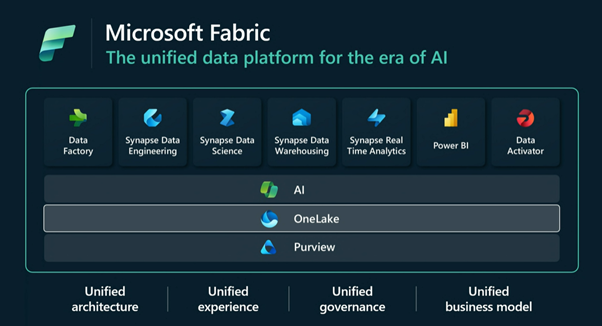
Fabric simplifies the entire data workflow by combining several powerful tools –Data Factory, Synapse Analytics, Data Explorer, and Power BI –into a unified, cloud-based platform. This integration allows for seamless data movement, robust data engineering, and advanced analytics, all within a single, user-friendly interface.
Exploring Microsoft Fabric Features
Fabric is packed to the rafters with features than unlock innovation and empower your organisation. We’ve hand-picked those that we have seen be particularly impactful, but there’s load more to learn about on Microsoft’s website.
Streamline Your Data Solutions
With Fabric, there is no longer a need to piece together multiple datasets, analytics, and BI solutions to get the business insights you require. This unified Software as a Service (SaaS) platform offers a single source of truth for all your data and analytics, offering secure and democratised insights. Utilising this powerful, open, and scalable solution will accelerate your time to value through effective cost management and spend optimisation, giving you the biggest bang for your buck.
Copilot integration
Fabric and Copilot go hand-in-hand, leveraging the power of AI to enhance data workflows across its suite of tools. This integration provides users with advanced capabilities for data processing, analytics, and visualisation, making data management more intuitive and efficient.
A Unified Experience
By integrating Data Factory, Synapse Analytics, Data Explorer, and Power BI into a seamless, cloud-based experience, Fabric provides a single pane of glass for data management. The open and governed Data Lakehouse foundation provides a cost-effective, performance-optimised fabric for business intelligence, machine learning, and AI workloads at any scale. It is the ideal foundation for migrating and modernising existing analytics solutions, whether these are data appliances or traditional data warehouses.
For New and Growing Analytics Customers
Fabric’s SaaS environment facilitates the rapid deployment of a complete end-to-end analytics engine from scratch. With its built-in security and governance capabilities, you can rest assured that your data and insights are well protected, even when you accelerate the creation or expansion of your analytics estate. Fabric allows you to get up to speed quickly, to keep pace with your competitors.
For Existing Synapse Customers
The next evolution of Synapse is here – as part of Fabric. Enjoy the limitless scale and benefits of Synapse in an easier-to-use SaaS solution, while adopting new capabilities that enhance your entire analytics approach. With the addition of Power BI, you can democratise the ability to uncover insights and create interactive reports across your organisation, empowering everyone to make more data-driven decisions in their everyday work.
For Existing Power BI Customers
Lastly, Fabric gives you access to powerful data tools and services like Azure Synapse within the familiar Power BI user experience. Unify these tools with your disparate data sources in the same environment to establish a single source of truth for all data, driving the ability for everyone to uncover more accurate and consistent insights. Additionally, the built-in security and governance capabilities ensure your data is protected, eliminating the security concerns associated with a patchwork analytics estate.
How can Fabric be used for your industry?
No matter what sector you work in, Fabric has the ability to transform your work.
Heathcare sector
The healthcare industry is riddled with complex data challenges, as it handles massive amounts of highly sensitive and highly regulated information.
As part of the NHS’s digital transformation plan, Electronic Heath Records (EHR) have become critical to medical professionals. EHRs show patients’ vital information, lab results and observation notes, and are a powerful tool for medical professionals as they can quickly diagnose those who are high risks for certain conditions, such as sepsis.
Fabric allows for an improved patient experience by giving healthcare organisations immediate access to structured and unstructured medical data in OneLake, laying a foundation that enables healthcare professionals to run analytics to identify patient needs in real-time.They can also leverage real-world data collected by clinical drug trials, using machine learning and artificial intelligence coupled with large sets of genomic and population data to gain new insights into drug efficacy. Healthcare providers will also be empowered to collaborate more closely by being able to securely share and access patient data and insights.
Finance and Insurance sector
The Financial Services Industry is heavily regulated, making the security of Microsoft products particularly valuable. Microsoft Fabric provides FSI professionals with secure, governed access to customer portfolio and market data, which allows them to enhance customer lifetime value and loyalty by offering a comprehensive view of a customer’s financial situation, facilitating targeted upselling and cross-selling of products and services tailored to the needs of individual clients.
For insurance firms, Microsoft Fabric supports improved risk assessment through analytical models on aggregated data. Insurance specialists can gain improved insights by integrating internal and external data, enabling them to offer customised solutions to their clients.
Overall, FSI organisations can leverage Fabric to ensure regulatory compliance, enhance customer experiences, and identify new revenue opportunities. It’s an FSI game-changer.
Public sector
For most government agencies, data is scattered from pillar to post. It cannot be accessed digitally, and it is not easily digestible. That all changes with Microsoft Fabric, where customers will be able to collect and store data in one single cloud location.
Government agencies will now be able to combine research and data across the public health sector and use machine learning and artificial intelligence to identify health risks and trends., leverage data to drive improved urban planning by offering better services and experiences, and stream data from IoT sensors and public utilities/transportation machinery can be ingested in OneLake with IoT Hub, for real-time analysis.
Retail Sector
Retailers face their own set of unique challenges when it comes to data. They often struggle with closing the gap between online and physical stores, integrating data in a meaningful way, and efficiently managing supply chains. With Microsoft Fabric, they can leverage real-time data to inform their merchandising strategy, leveraging customer data to learn what target audiences value and curating personalised shopping experiences.
Retailers can also optimise digital spend by creating models that identify who and where to target buyers based on data trends, while tracking store activity by ingesting real-time data from in-store sensors and cameras will identify even more in-person areas for optimisation.
Lastly, and most likely top-of-mind for many retailers, is being empowered to deliver an intelligent supply chain. By using data to anticipate customer demand on a local and global scale, retailers can get the right product, at the right price, to the right customer, at the right time – closing the gap between demand and fulfilment.
Manufacturing
The manufacturing sector generates vast amounts of data from sensors, machinery, enterprise systems, and human interactions. However, much of this data remains isolated, unstructured, and underutilised, restricting the potential for leveraging data-driven insights and fostering innovation.
Microsoft Fabric enhances manufacturing operations by integrating data from various sources into its unified platform, enabling real-time analytics and insights that allows manufacturers to monitor production processes continuously, optimise schedules, and perform predictive maintenance to reduce downtime and improve product quality. Advanced AI-driven tools facilitate better decision-making and operational efficiency, leading to cost reduction and increased productivity, and the cloud-based infrastructure of Fabric ensures scalability and flexibility, adapting to changing production needs and supporting long-term growth.
So, what’s next?
Many businesses are eager to revolutionise their data management and deploy Microsoft Fabric – but it’s important to understand how each solution can be tailored to your specific business needs before taking the leap.
We have an interactive workshop designed for you to understand exactly how you can adopt Fabric. Led by our Cloud Evangelist, Leon Godwin, this workshop is a two-way open discussion where you can build your business case and learn what your next steps should be.
Register your interest here, and let’s get your data journey started.
If you’re asking us, Microsoft Azure is the best cloud platform in the world. Sure, maybe as an Azure Expert MSP and one of Microsoft closest partners we’re biased, but no platform is better suited to successful, innovative, and expanding organisations than Azure.
It has more availability zones in more regions than any of its competitors, and its seamless integration with the much wider family of Microsoft products is a huge benefit to businesses.
But we aren’t blind to the fact that there are situations and scenarios that might require a slightly different approach. Whether it’s maintaining an on-premises datacentre as part of your IT landscape or you benefit from running a multi-cloud environment, Azure might not always be the perfect fit – but that doesn’t mean you should miss out on all of its advantages… and that’s where Azure Arc comes in.
So, what is Azure Arc?
Azure Arc is a family of services that enables you to extend the Azure management plane to any infrastructure – whether it’s on-premises, in other clouds, or at the edge. This means you can manage a diverse set of resources – be it servers, Kubernetes clusters, or databases – from a single, unified platform.
It puts your operations, management, security and governance capabilities under one pane of glass. Arc allows your Azure environment to interact with your AWS, Google Cloud or VMware estates seamlessly, creates a pathway between your cloud and on-premises platforms, and simplifies the management and maintenance of your entire IT ecosystem.
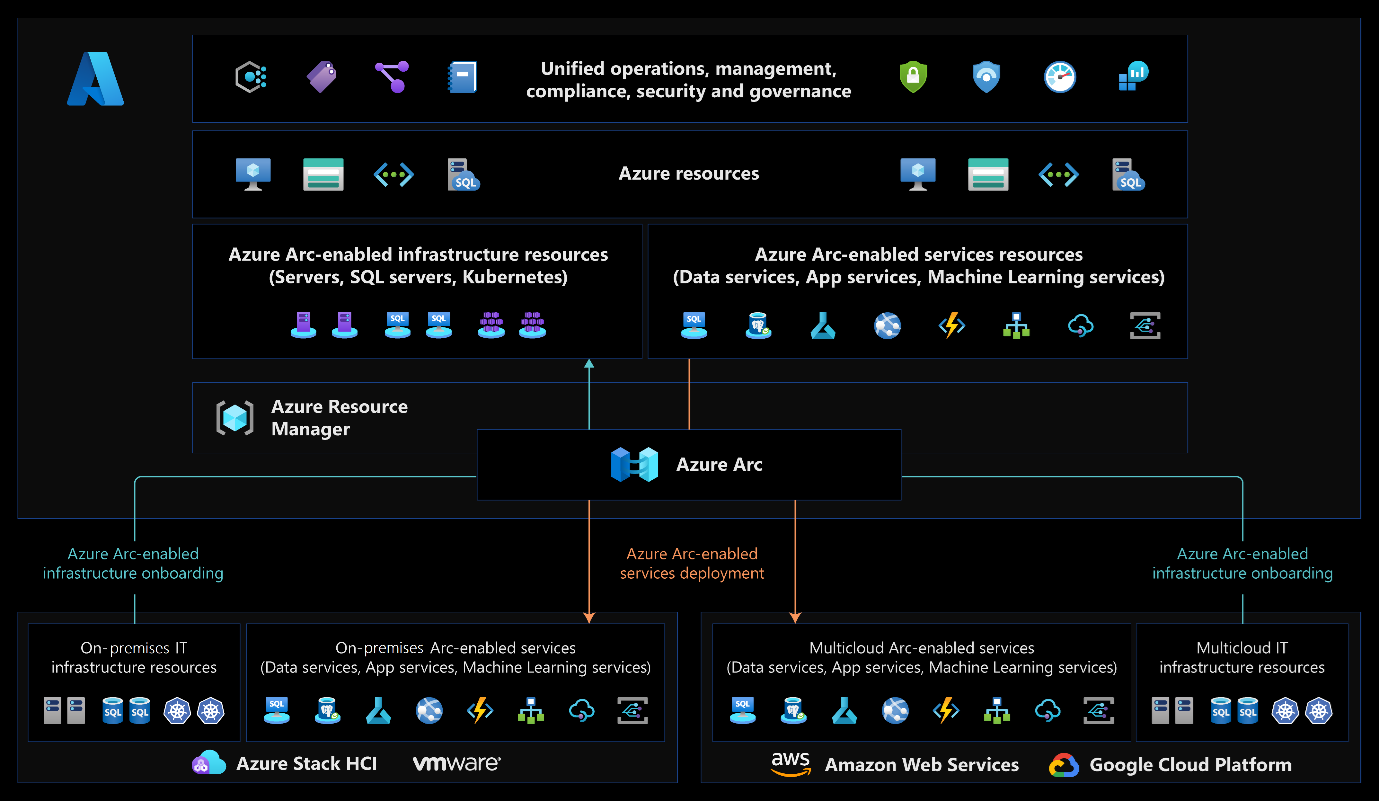
And it doesn’t stop there. Azure Arc-enabled services open up a whole host additional scenarios that include developing your containerised applications in the cloud, leveraging your on-premises Kubernetes clusters as custom locations, and using GitOps to push your applications out to wherever you need them. Microsoft has also enabled a number of containerised PaaS services to be deployed to these custom locations, including data services, app services, and machine learning.
It opens up a world of opportunity for your business and its IT ecosystem.
Benefits of Azure Arc
Now in full, this is a long list. We’ve tried to keep it short and snappy here, but there’s loads more to learn about on Microsoft’s website.
Unified Management
Managing a sprawling IT environment can be a nightmare. With Azure Arc, you get a single pane of glass to oversee your virtual machines, SQL servers, Kubernetes clusters, and vSphere/Hyper-V private clouds, wherever they are. This centralised management means you don’t need to juggle multiple consoles or worry about disparate systems.
Whether your resources are on-premises or in different clouds, Azure Arc brings them under one roof. This not only simplifies operations but also makes it easier to enforce policies and monitor performance.
Consistency and Compliance
Maintaining consistency and compliance across various environments can be challenging, especially with ever-evolving regulation. The governance features in Azure have helped numerous customers to become compliant and Azure Arc extends that capability to ensure that your governance and security is more consistent.
It allows you to apply and enforce policies across all your resources using Azure Policy to give you a central view of your governance posture, highlighting the resources that need remediation, and giving you additional tools to help ensure your estate is fully compliant.
Cost Efficiency
Managing costs is a top priority for any organisation. Azure Arc helps you optimise resource allocation and utilise Azure’s cost management tools to achieve significant savings.
By extending Azure’s robust cost management and optimisation features to your entire environment, you know that you’re getting the most out of your existing investments while taking full advantage of cloud capabilities, and helping your team to address the skills gap as you accelerate your innovation journey. This hybrid cost model can be especially beneficial for companies looking to balance performance and budget.
Use Cases
Let’s apply some Azure Arc use cases to a few fictional organisations to put things into context.
Hybrid Cloud Monitoring
- Scenario: Eric Entertainment, a large multinational enterprise with a mix of on-premises and cloud-based applications, wants to monitor its diverse and sprawling cloud environment.
- Solution: Using Azure Arc, Eric Entertainment can manage its entire infrastructure seamlessly. By using Azure Monitoring across its whole estate, the protection of Microsoft Defender for Cloud and Microsoft Sentinel will reach even further, and keep the organisation safe in the face of a growing, and increasingly complex, threat landscape.
Achieve compliancy across your estate
- Scenario: The Department for Hedgehogs needs to prove its compliance with UK OFFICIAL and ISO 27001 across the whole estate.
- Solution: The organisation can extend Azure Policy’s compliance reporting across the entire infrastructure estate with Azure Arc They will gain visibility of virtual machines that are non-compliant with standard Guest Configuration policies within the UK OFFICIAL and ISO 27001 policy initiatives, and be able to consolidate tooling and processes for a uniform approach.
Automate at scale
- Scenario: Spikey Shoes, an international footwear manufacturer, has IT systems spread across multiple head office and factory locations and wants to innovate quickly.
- Solution: Azure Arc simplifies operations and gives the organisation new tools to help manage its estate. You can use Azure Update Management v2 for your patching, or Azure Arc as the vehicle to manage your Extended Support Update licences. Azure virtual machine extensions will enable you to run scripting at scale, apply declarative configurations, centralise certificates and secrets, and more, while you use Windows Admin Centre and SSH to manage your Windows and Linux machines wherever they are, without exposing them to the internet.
Disaster Recovery and Backup
- Scenario: Homes4Hedgehogs, a national charity, is seeking robust disaster recovery solutions to ensure operational continuity in case of unforeseen disruptions.
- Solution: Azure Arc allows for seamless integration with Azure’s backup and disaster recovery services, which ensures data protection and business continuity, even in the face of disaster. For instance, by using Azure Site Recovery in conjunction with Azure Arc, the organisation can replicate on-premises workloads in Azure, ensuring that critical applications and data are always available, even if the primary datacentre experiences an outage.
How to Get Started with Azure Arc
It might all sound rather complex, but getting started with Azure Arc is easier than you might think. Here are a few steps to help you begin:
1. Assess your environment: Start by evaluating your current infrastructure. Identify the resources you want to manage with Azure Arc – such as servers, Kubernetes clusters, or databases.
2. Connect Your Resources: Use the Azure portal to connect your resources to Azure Arc. This involves installing the Azure Arc agent on your servers and registering your Kubernetes clusters.
3. Apply Policies and Configurations: Leverage Azure Policy to apply configurations and enforce compliance across all your connected resources. This ensures that your entire environment adheres to the same standards.
4. Monitor and Manage: Use Azure Monitor to keep an eye on the performance and health of your resources. Azure Arc provides a centralised view, making it easier to detect and address issues promptly.
5. Scale and Optimise: Take advantage of Azure’s scalability and optimisation tools to manage costs and resources efficiently. Azure Arc allows you to scale your infrastructure based on demand, ensuring that you’re always prepared for any workload.
Azure Arc is a game-changer for organisations looking to streamline their IT operations, ensure consistency, and harness the full power of the cloud. Whether you’re managing hybrid environments, edge computing, or optimising DevOps processes, Azure Arc’s got your back.
With a unified management platform, by enhancing compliance, and offering flexibility and scalability, Azure Arc empowers you and your business to achieve more.
Want to learn more from the experts? You can level up your IT infrastructure by partnering with a successful, experienced cloud managed service provider like Cloud Direct. To find out more about how we can help you, let’s chat.
Organisations within the NHS are facing growing public uncertainty around the safety of their data. Results from a recent survey on public attitudes to data in the NHS show that four out of five patients worry that NHS IT systems may be vulnerable to cyber-attacks. Just recently, a ‘large volume’ of data was stolen from NHS Dumfries and Galloway and published on the dark web. Acts like these are increasing across NHS and social care organisations in the UK and show no signs of slowing down.
With increased remote working and Bring Your Own Device policies implemented in the NHS since the onset of COVID-19, security protection has faltered – and organisations must find a turning point.
It’s critical that the NHS and social care organisations win back the trust of the public and guarantee that patient data is in safe hands. With the publication of its Cyber Security Strategy to 2030, the government has identified the need for increased training and continued self-assessment through the Data Security and Protection Toolkit, but that doesn’t just happen. It’s time for health and social care organisations to take a proactive approach to cybersecurity resilience before threats become a reality.
Why are NHS organisations increasingly targeted?
The NHS is a behemoth. It is the UK’s largest employer, with more than 1.3 million full-time staff. This alone makes it a high-value target for cybercriminals, but the personal and confidential nature of the data it holds also plays a key role.
An organisation this large can be extremely difficult to keep secure, but why is that?
Resource Constraints
- It’s a common belief that the NHS is underfunded, and these financial implications can impact the NHS’s ability to invest in robust cybersecurity infrastructure.
- With the NHS facing one of the worst staffing crises in its history, the number of trained personnel is getting scarcer across all departments, and the ability to retain cybersecurity experts is difficult due to competition from other sectors.
Inefficient Infrastructure
- The NHS is made up of thousands of hospitals, GP surgeries, clinics and administrative units, each with its own IT systems
- These inconsistencies in infrastructure, legacy systems, and lack of standardisation can make it harder for organisations to implement cohesive security measures
- The ability to upgrade and secure such a diverse landscape can pose a significant challenge to IT and Security leaders
Easy target for cybercriminals
- The NHS holds vast amounts of sensitive patient data that can be sold, making it an attractive target for cyberattacks
- Ransomware attacks, data theft, and indiscriminate malware campaigns are specifically created to target healthcare institutions and their infrastructure
- The consequences of successful attacks can disrupt patient care, compromise privacy and damage the reputation of the NHS
To help address these challenges, the NHS and the Department of Health and Social Care have developed a comprehensive cybersecurity strategy, which aims to enhance resilience, improve information sharing and protect valuable patient data. What can you do to get on board and rethink your cybersecurity strategy?
Introducing the Microsoft Security Toolkit
If you’re looking to start improving your security posture and stay safe from threats, now is the time. Microsoft has invested over $20 billion in its security offerings to help organisations stay safe.
Developing a comprehensive set of security tools that are already being integrated into some NHS organisations through a landmark deal with Microsoft in 2023. These include…
- Microsoft Defender
- Microsoft Sentinel
- Microsoft Purview
- Copilot for Security
You have probably used, or at least heard of, some of these products, but ones like Copilot for Security and Purview may be new to you – let’s take a deeper dive into each one and understand how these Microsoft Cloud Security tools can benefit your NHS organisation.
Microsoft Defender
The Microsoft Defender suite is a collection of products that will really bolster your security standing. Different versions of Defender, such as for Cloud, Cloud Applications and Microsoft 365 are designed to keep all areas of your organisation protected. The most popular among NHS organisations is Microsoft Defender for Endpoint.
Defender for Endpoint is a detection and response, enterprise endpoint security platform that is designed to prevent, detect, investigate, and respond to real-time advanced threats. It improves overall cyber security capabilities, and NHS organisations stand to benefit from enhanced Cyber Security Operations Centre (CSOC) services, which further improves cyber security protection for the NHS.
The platform gathers network telemetry from devices like laptops, PCs, servers and phones, and send it to Microsoft Cloud services to detect potential cybersecurity threats, before acting to prevent the spread of these threats across the network. Defender alerts local system managers and the CSOC to potential security incidents, offering a real-time, organisation-wide view down to individual devices. This allows the CSOC to quickly coordinate responses, minimising disruption to clinical services.
Microsoft Sentinel
Microsoft Sentinel is a Security Information and Event Management platform that gives NHS organisations the visibility to see and stop threats across the entire organisation. Built on the cloud, it offers intelligent security analytics that can help health and social care organisations stay ahead of sophisticated threats.
Sentinel offers key benefits for NHS organisations by centralising network monitoring and providing real-time visibility and threat detection. This 24/7 transparency helps protect sensitive patient data and ensures operational continuity with scalable, cloud-based architecture, reducing costs and integrating data from various sources for a comprehensive security view. Sentinel minimises false positives, proactively identifies threats, and automates routine tasks, freeing up IT staff for more complex challenges. Its deep investigation tools help NHS organisations understand and address the root causes of security incidents, enhancing their overall cybersecurity posture.
Microsoft Purview
Microsoft Purview is a comprehensive data governance and compliance solution that helps organisations manage and protect their data across various environments, including on-premises, multi-cloud, and SaaS applications. It offers capabilities such as data discovery, classification, and lineage tracking to ensure data is managed and utilised effectively while maintaining compliance with regulatory requirements.
For a health organisation using Purview, you can benefit from detailed visibility into data usage and access, lowering the risk of data breaches and ensuring that only authorised personnel can access critical data. By tracking data flow and improving data quality with lineage and lifecycle management, Purview streamlines data management and helps mitigate risks by identifying and addressing data issues early, preventing potential problems. Automating governance tasks with Purview also allows IT staff to focus on strategic initiatives, improving overall operational efficiency.
Copilot for Security
Copilot for Security, launched on 1st April 2024, is a feature integrated into Microsoft’s security solutions, leveraging advanced AI and machine learning to assist security teams in identifying, responding to, and mitigating threats. Built on the foundation of Microsoft’s comprehensive security platforms, Copilot for Security aims to enhance the efficiency and effectiveness of security operations.
For NHS organisations, it can enhance the ability to protect sensitive data, ensure compliance with regulatory standards, and improve overall security posture. By automating routine security tasks and providing advanced threat detection capabilities, it allows IT and security teams to focus on more critical and strategic aspects of their operations. The AI model can also continually learn from new threats and security incidents, improving its capabilities and making sure your NHS organisation is more secure.
Want to learn more about Copilot for Security? Here’s a quick introduction.
What’s next?
As we know, data security is always a top priority for NHS organisations, and we don’t want your organisation to fall victim to a cyberattack. Every year, health and social care organisations that have access to NHS Patient Data and Systems should complete a Data Security and Protection Toolkit self-assessment, to benchmark itself against the National Data Guardian’s 10 data security standards.
To make sure you exceed these standards, be proactive and make sure you are continually reviewing your cyber security strategy. Make sure you have the latest and innovative cloud cybersecurity tools integrated within your IT systems that align with your security strategy and goals.
Now that you know about the cloud security tools available to help your NHS organisation stay secure, you can start to explore options, like partnering with a Cloud Managed Service Provider. By working with a CMSP, you unlock unrivalled, around-the-clock, in-depth expertise and guidance.
An Azure Expert MSP, like Cloud Direct, can also gain you access to Microsoft funding pots that other partners can’t, which could unlock exciting opportunities for your NHS organisation to de-risk and accelerate your security performance.
Cloud Direct offers funded assessments and workshops that link to the Microsoft Security Toolkit, so if you’re interested in exploring these options then get in touch with a member of our team and find out how you can add a little sparkle to your security journey.
Public sector organisations are feeling the pinch. They’re facing uncertain futures and, clampdowns across all areas of spending, which is putting a strain on resources and affecting the services they provide for their communities.
With stricter budget controls, many public sector IT leaders fear spending on new technology. But, as a result, they are missing out on opportunities that, in this day and age, they simply can’t afford to pass up on. Tied with ever-evolving cybersecurity threats towards the public sector, the risk of doing nothing is growing. But you’re probably thinking, what has this got to do with cloud technology?
With the fear of spending, the increase in security threats and let’s not forget, the increasing costs of on-premises infrastructure like VMWare, a balance needs to be found. The answer to all these issues? Cloud technology. Let’s dive into Cloud Economics 101 so that you can understand the benefits, costs and principles of cloud technology to help you find that balance.
What is cloud economics?
Simply put, cloud economics is the process of understanding the costs involved with ownership of cloud technology, the benefits of cloud technology over on-premises infrastructure, and ongoing cost optimisation strategies that will maximise your cloud return on investment. As a public sector IT leader, it can be tempting to hop straight into a digital transformation journey and assume the costs and benefits involved, but it’s not usually quite so black and white.
So why is it important to consider cloud economics?
- It can help you align your cloud investment with business goals, which will help you budget and invest efficiently and make sure you are supporting your goals, like security compliance or streamlined operations.
- You can assess where you should start to enhance innovation by looking at the financial effects of different cloud services and can innovate within a cost-effective framework that empowers innovation.
- Public sector organisations can optimise their cloud spending and cloud resources, meaning you can start to find savings in cloud costs with services you may not be using, allowing you to reallocate resources to other cloud areas that can foster growth.
- A thorough cloud economics analysis helps make a business case for migrating from on-premises infrastructure to the cloud. A cost-benefit analysis can help you:
- Curate a clear business case, including how to measure performance over time
- Compare the risks and rewards associated with the cloud vs on-premises
- Decide whether you want to move all components to the cloud, or only migrate some applications to the cloud
Overall, cloud economics is about understanding the financial implications of cloud adoption and optimising resource utilisation to achieve business objectives effectively and efficiently. There are a few areas of cloud economics to take a closer look at…
Total Cost of Ownership
When it comes to cloud technology, the total cost of ownership (TCO) covers the costs incurred with adopting and operating cloud technology. Getting an accurate TCO for the cloud means evaluating the price differences between on-premises and cloud solutions, as well as the tangible benefits of each, to help you come to a decision.
For a public sector organisation, IT costing is imperative and undertaking a sound TCO of your cloud solutions can make sure you are adopting technology that aligns with your objectives and budget constraints.
Cloud solutions like Microsoft Azure enable public sector organisations to conduct comparative TCO analyses between different deployment options, such as on-premises infrastructure and cloud solutions. Azure’s TCO Calculator allows public sector organisations to input their current infrastructure costs and usage patterns and compare them with the projected costs of deploying equivalent workloads in Azure. This can help public sector organisations make informed decisions about the most cost-effective deployment options based on their specific requirements and budget constraints.
Overall, the goal is to achieve a lower TCO compared to on-premises infrastructure, but it can also be about justifying a higher TCO by making sure the tangible benefits of cloud solutions are listed as well.
CapEx vs OpEx
Many public sector organisations are still paying for traditional on-premises IT infrastructure that requires upfront investment in hardware, software licenses and data centre facilities. Public sector organisations may face continued challenges in securing funding for capital expenditures, especially when budgets are limited, and on-premises infrastructure costs are rising.
With the cloud, spending is often shifted from a Capital Expenditure (CapEx) model to Operational Expenditure (OpEx), meaning public sector organisations will pay for the cloud services on a recurring basis, typically monthly or annually, rather than in lump sums. This pay-as-you-go model aligns expenses with actual usage, providing greater financial flexibility and predictability. By moving to an OpEx model of spending, public sector organisations can redirect funds towards other strategic initiatives, such as improving service delivery, enhancing citizen engagement, or investing in innovation.
OpEx-based cloud pricing also enables public sector organisations to better align IT spending with revenue streams and operational budgets. This flexibility allows public sector organisations to respond more effectively to budget constraints, economic fluctuations and unforeseen events without sacrificing service quality or performance.
Pay-as-you-go model
Shifting to an OpEx model unlocks the ability to operate on a pay-as-you-go model or subscription-based pricing model, meaning that you end up only paying for the resources that you need.
For many public sector organisations that have limited budgets and are under pressure to optimise their spending while still delivering essential public services, a pay-as-you-model, much like Microsoft Azure’s, eliminates the need for large upfront investments in the future. This means it can help you to better manage your finances by avoiding over-provisioning of resources typically seen with legacy on-premises set-ups.
Let’s also not forget the scalability and flexibility of cloud technology. For example, Azure’s pay-as-you-go model enables public sector organisations to scale their resources up and down depending on expected or unexpected demand. By leveraging this pay-as-you-go model, public sector organisations benefit from cost savings, increased cloud agility and scalability, while avoiding any unnecessary financial constraints that can come with on-premises infrastructure.
Cost optimisation
Cloud economics also involves optimising your cloud costs by selecting the right mix of cloud services and pricing options. By leveraging cost optimisation strategies and tools, public sector organisations can effectively manage their cloud expenses and maximise the value of their cloud investments.
Within Microsoft Azure, there are several tools and services that can help you identify cost-saving opportunities.
- Azure offers a wide range of virtual machine (VM) types and sizes, allowing public sector organisations to match their workloads to the most cost-effective and performance-optimised configurations. Azure Advisor provides recommendations for rightsizing VMs based on historical data usage, helping public sector organisations identify over-provisioned or under-utilised instances and rightsize them to minimise costs while maintaining
- Azure Cost Management and Billing provides insights into spending patterns and identifies opportunities for optimisation, such as consolidating underutilised resources, optimising storage usage, or leveraging serverless computer services like Azure Functions. It can also monitor and optimise cloud spending continuously, allowing public sector organisations to set budgets, configure alerts for cost overruns, and implement policies to enforce cost-saving measures.
- Azure Hybrid Benefit enables public sector organisations to apply existing on-premises Windows Server or SQL Server licenses to Azure VMs. This significantly reduces costs as you’ll be leveraging your on-premises investments in the cloud.
Cloud cost optimisation is important for public sector organisations to ensure efficient use of resources, maintain financial accountability, improve operational efficiency, support innovation, manage risks and contribute to sustainability efforts. These benefits collectively enhance the organisation’s ability to serve the public effectively.
Value-based pricing
When looking at cloud economics, you need to go beyond just focusing on the costs and look at what value the cloud can bring to your public sector organisation. You should assess what strategic benefits you will gain with cloud adoption, such as its scalability and how it can help streamline operations and empower innovation.
Let’s take a look at how Microsoft Azure can offer value…
- Azure’s cloud services allow public sector organisations to adjust their infrastructure based on real-time needs. This flexibility supports the rapid development and deployment of new services or the scaling of existing ones without the delays associated with on-premises procurement and set-up
- Azure offers access to a wide range of innovative technologies like its Azure AI Studio and Azure Machine Learning. With these technologies at your fingertips, you can empower innovation and enhance your public services
- Azure’s robust analytics platforms, like Synapse Analytics and Power BI, can allow public sector organisations to make more data-driven decisions. For example, we often hear of smart city initiatives using data analytics to optimise traffic management, reduce energy consumption and improve public safety
- Azure supports various collaboration tools and platforms, such as Microsoft Teams and SharePoint, which can help facilitate improved communication and coordination between stakeholders and groups within public sector organisations.
The values which Azure provides are limitless, but we wanted to demonstrate a few examples to show the effect of value-based pricing as part of cloud economics. By focusing on these values, public sector organisations not only reduce costs but also gain strategic advantages through enhanced agility, innovation and operational efficiency. These benefits ultimately translate into improved public services and better resource management.
So, we’ve gone through some of the key principles of cloud economics, but what’s next?
Many public sector organisations will have to create strategic business cases and follow strict guidelines when it comes to adopting new technology. There is no one-size-fits-all approach to public sector organisations, but we do know the final decision doesn’t just come down to the IT team.
Quite often in public sector organisations, we see wider project teams making these big decisions. Led by the IT team, project teams are made of key stakeholders, like board directors, financial leaders, legal, and end users such as other departments and agencies within your organisation. By considering all of these principles and assessing cloud economics, you can help create a strong business case and demonstrate the financial implications and benefits of cloud adoption for your public sector organisation to each of these parties.
By thoroughly assessing these cloud economic principles, you greatly increase the chances of getting your organisation’s stakeholders on board and quell any fears that they have about the costs involved in a cloud migration.
What’s next?
Understanding the costs involved with a cloud migration project can be complex, but you don’t have to do this alone. By engaging with a Cloud Managed Service Provider that has all the appropriate Microsoft Azure accreditations, together you can identify the value of an Azure adoption and lay the right foundations for a successful migration project.
We offer Microsoft Solution Assessments which can help with cost modelling, target state planning, and discovering how much Microsoft funding you are eligible for. These assessments will also help you develop a clear Azure migration roadmap and business case that you can use to demonstrate the costs and value to your public sector stakeholders. Get in touch, and let’s get going.
There’s no denying that the retail landscape is fiercely competitive, with exceptional customer experience often deciding who comes out on top. One way to get ahead – and stay ahead – of the competition is by embracing cutting-edge cloud technologies like Microsoft Azure. With its suite of cloud and innovative services, Azure offers an extensive list of benefits for retailers that can enhance their customer experience, and we’ve picked out six of the best.
Scalability and Flexibility
One of the foremost challenges retailers face is being able to manage fluctuating demand, especially during peak trading seasons or promotional events. With Azure, retailers have access to unparalleled scalability that can help them dynamically scale their infrastructure up or down based on demand. Whether it’s handling a sudden surge in website traffic or ramping up power for data analysis, Azure ensures retailers have the resources they need, exactly when they need them the most.
But what has this got to do with the customer experience? Well, with this level of flexibility and scalability, you and your customers can trust that you won’t have to worry about any IT infrastructure constraints that hinder your services – which keeps your customers happy!
Data-driven Insights
Data, data, data – you might be getting tired of hearing about it, but we can’t stress how important it is to your business! As a retailer, you have vast amounts of customer data at your fingertips, so don’t let it go to waste.
Knowing where to start with your data can be daunting, but this is where Azure’s advanced analytics capabilities come in. Azure offers a suite of tools, including Azure Machine Learning and Azure Synapse Analytics, that gives retailers the ability to gain valuable insights into customer preferences, behaviour patterns and trends. Armed with this knowledge, you can personalise marketing efforts, optimise inventory management and anticipate customer needs, enhancing the overall shopping experience.
Omnichannel Integration
Today, customers expect a seamless shopping experience across multiple channels – whether they’re online, in-store, on a mobile device or the app. Microsoft Azure facilitates omnichannel integration by providing a unified platform for retailers to manage their digital presence, allowing you to integrate e-commerce platforms, mobile apps, point-of-sale systems and CRM tools to ensure consistency and coherence across all touchpoints. An omnichannel approach enables retailers to deliver a cohesive and personalised experience to customers, whichever way they choose to interact with your company.
Security and Compliance
We live in an era where sophisticated cyber attacks are increasing and regulatory requirements are getting much stricter, meaning enhanced security measures and compliance are of paramount importance for retailers. Azure offers industry-leading security features and compliance certifications, providing retailers with peace of mind when it comes to protecting sensitive customer data.
From advanced threat detection and a zero trust approach to encryption and identity management, Azure helps to protect retail applications and infrastructure from all anglespossible cyber attacks. Furthermore, Azure’s compliance with standards such as GDPR means retailers remain compliant with regulatory mandates, reducing the risk of fines and reputational harm. A secure retail envrionemtn ultimately leads to gaining, and maintain, the trust of your customers.
Access to the Microsoft Ecosystem
It’s no secret that an Azure migration gives retailers access to a wider range of innovative Microsoft tools and services, like Dynamics 365 and Office 365, which empower retailers to streamline business processes from inventory management to customer service. For example, you can leverage Azure AI’s capabilities to power chatbots within Dynamics 365 Customer Service, giving customers instant support and a better overall experience.
And let’s not forget that all important data. Azure’s interoperability with familiar tools like Microsoft Power BI allows retailers to visualise and analyse data easily, driving informed decision-making for your business.
Unrivalled Innovation
Microsoft’s commitment to innovation and its future-ready capabilities make it an excellent choice for retailers that are aiming to enhance their customer experience. Azure is a continually evolving platform, with new features, services and improvements that retailers can leverage to unleash innovation unveiled all the time.
For example, some retailers are already using its AI and Machine Learning abilities tools to analyse customer data, predict trends and personalise customer interactions. Many are also using these innovative tools for demand forecasting, helping retailers to predict demand accurately, and optimising inventory management so that their customers are always happy. The possibilities are endless.
It’s clear that Microsoft Azure is the way forward for retailers who want to innovate, grow and improve their customer experience. Now you’ve learnt a little more about its advanced scalability, omnichannel integration and security, you can grow your retail business with data-driven insights and its unrivalled innovative AI tools, and add sparkle to your retail business by delivering personalised and secure experiences that keep your customers coming back for more!
What can you do next?
We know that Microsoft Cloud and its advanced tools and capabilities will be crucial to the long-term success of your retail organisation. As a leading UK Microsoft Solutions Partner and Azure Expert Managed Service Provider, we can assist you in your digital transformation journey.
Whether you’re at the forefront of innovation or just starting out on your digital transformation journey, our experts are here to help you make the most of technology – so let’s talk.
While you’re here, check out our Microsoft Cloud Bootcamp for Retailers webinar. In this two-part on-demand series, hear from Leon Godwin, Cloud Evangelist, about the seven steps you can take to transform your customer experience.
If we asked a large group of people what the most important department of a business if, the responses would vary. Many would say the senior leadership team, whose direction and management guides the business forward. Some would say the finance department, making sure the money keeps moving and that people get paid. Maybe it’s sales, for bringing the money in in the first place?
We’re here to make the case for the IT department – the backbone of any modern business.
We might be biased, but the case is a compelling one. Gone are the days of basement-dwelling IT teams telling people to turn it off and back on again (even if those days never really existed in the first place) and instead we are in an age whereby technology shapes and impacts each and every part of the business. From transforming the business with a forward-thinking artificial intelligence strategy, to maintaining an accessible and effective cloud environment, IT teams of today have a profound impact on how each part of the business operates day in, day out.
It is therefore important that you, as a figurehead in the IT department, understand the impact you are having on everybody else and the work they are doing. Starting a new job can be daunting, but by building relationships with your internal stakeholders early on, you set yourself up for success.
To help get you started, we’ve set out a list of key people to speak to, and what to speak to them about.
Human Resources
Your HR department plays a pivotal role in the success of your organisation by attracting, retaining, and developing its employees. With the best people on-board, all pulling the same direction, a business best positions itself to achieve its goals, so the importance of the HR team cannot be overstated.
They can, however, be empowered. The relationship between HR and IT is clear, and covers everything from applicant tracking and testing systems during the hiring process to e-learning platforms and employee wellbeing software during the course of their employment. You’ll also work closely on onboarding new employees and ensuring they have access to the right technology and data, managing remote working policies, and offboarding employees.
In your position as an IT decision maker, you have a direct link to the success of the HR team and, as a result, the success of the business. Whether it’s ensuring that AI is introduced ethically and effectively into your HR processes, or the team wants to be able to conduct accurate sentiment analysis by investigating and unpicking its data, a helpful and impactful HR team relies on technology, so building and maintaining this relationship is a must.
Speak to… the Head of HR, HR Director, or HR Manager. Find out who is in charge of the people aspect of your business, and book in a meeting. Sit down with a cuppa and understand what technologies they are already using, the challenges they are facing, and how your can work together to create an even greater, happier, and more successful workforce.
Operations
The efficiency of your operations can be the difference between the world’s most successful business, and a failing one. Jeff Bezos built the Amazon empire on the foundation of ruthless operational efficiency.
Now, building the world’s biggest ecommerce platform might not be your goal, but the lessons and takeaways are there. By optimising productivity, reducing costs, and improving the quality of your products or services all at once, your business will be best positioned to succeed – and the effective use of technology holds the key.
This might start with Enterprise resource planning systems that pull together a range of operational functions to provide operations leaders with the information and insight they need to highlight, analyse, and tackle inefficiencies, and ensure they remain agile, responsive, and resilient in today’s ever-changing business landscape. You may then look at adopting an effective DevOps methodology, and creating a process that enables constant innovation and development within your organisation. Ultimately, it could then escalate to considering the data and artificial intelligence platforms that can transform operations teams by enabling everything from predictive machine maintenance to automated inventory management systems.
Effective technology usage fuels improved performance, productivity, and efficiency, and you’re in the position to help your Operations team achieve that.
Speak to… the Chief Operations Officer or Head of Operations. They will have the best insight into how their department is currently using technology and will be willing to listen to how your policies and plans can drive further efficiencies and greater productivity within their team.
Sales and Marketing
Your sales and marketing teams are the ones responsible for driving revenue growth. It’s their job to build awareness, grow pipelines, and convert customers, and in a modern business world they are increasingly powered by data. They generate tonnes of the stuff – everything from information on social media followers and website users to insights on customer intent and sales performance.
Your data strategies will therefore play a key role in the work of your Sales and Marketing teams. They will rely on your security and governance policies, require constant access to the data they generate, and need to be able to unpack that information, pull it apart, and act on it.
They also represent your organisation to its customer base. They are brand advocates and have an element of control over how your business is perceived. Poor data governance and patchy IT practices are quick to hit the headlines and have a significant impact on the trust people have in your brand. Maintaining a close relationship with those who are speaking directly to your customer base is, therefore, crucial.
Speak to… the Heads of Sales and Marketing. Each will be experiencing their own pain points when it comes to technology, so individual meetings will also be beneficial, but sitting down with them together will also provide insight and allow to you identify potential efficiencies that will create smoother, more seamless processes in this part of the business.
Finance
Whether you’re building the bottom line in the interest of shareholders, or you’re a non-profit trying to serve its local community, money matters. The finance department is the backbone of almost any organisation, and is responsible for making payments, tracking performance and, most importantly in your case, setting budgets.
Finance is analytical by nature – it is, quite literally, a numbers game. IT and finance can, therefore, form a perfect partnership and lean heavily on one another in their respective best interests. A healthy IT budget makes your life easier, while effective technology processes and innovative analytics tools stand to benefit their work.
But securing that budget relies on a healthy relationship between you on your financial controller. It’s wise to keep them involved in your project plans from the get-go, so that you can demonstrate the value and potential of your ideas, the understand the business value they provide, and get them bought in from the outset. Improved efficiencies, enhanced productivity and an empowered workforce are all music to a CFO’s ears because they drive business performance.
Speak to… the Chief Financial Officer or Head of Finance. Having a strong relationship with these roles is an absolute must for an IT leader. Not only do they ultimately hold the purse strings, but it is in their best interests to identify and implement the most effective and efficient processes to bolster the organisation’s bottom line. You are the employee that will help them unlock those efficiencies, both in the finance department and across the business.
Senior Leadership Team
In today’s world, businesses are built on technology. Whether your organisation was founded a century ago or started in a bedroom late last week, technology is everywhere you look, in every process that is undertaken, in every room of the office. Your IT strategy is no longer a standalone piece of work – it should be entwined in your wider business strategy, and play a key role in directing the organisation forward.
That’s why you’ve been hired – to shape the way in which technology is used across the business, and help it reach its goals.
So, who better to speak to than the people setting those goals, and driving that performance? Whether you’re part of a small team or a multinational organisation, understanding the driving force behind it will paint the picture for how technology can play its part. It might be that the goal is to implement automated processes to drive efficiencies, or it might be to bolster the business’ security standing. The best way to find out is straight from the horse’s mouth.
Speak to… the CEO, Owner, or Managing Director. Sit down with whoever is ultimately in charge of your business. As the key decision maker in the business, who has control of its vision and direction, your input will have a direct impact on them and, therefore, the business as a whole. If you start singing from the same hymn sheet now, you’ll help your business and its senior leadership team meet their goals quicker.
So, who does your work as an IT leader impact? It’s everybody, and we’ve only scratched the surface. The changes you make and the policies you enforce will also affect administration teams, your business’ research and development, your legal or PR departments… the list really is endless.
Your department is the catalyst for change, so it’s really important that, in the first few days and weeks of your new role, you meet with leaders in these departments to understand their experiences and challenges and discover ways in which your role as an IT leader can make a positive impact. Then – and only then – will you set yourself up for long-term success within your organisation.
It’s time to renovate your garden. You’re fed up with the view from your kitchen window as you look outdoors and see a space that passes as usable for the odd barbecue or to kick a ball around in, but you know it isn’t everything it could be. You’ve got a rusty table for two, the fence didn’t survive the last storm, and the weeds are winning the war over your border plants. It’s only taken a couple of summers to get to this point since you last spent hours out there tidying the place up.
You’ve decided it’s time to act. So, do you do it all over again in the hope of achieving a different, longer-lasting outcome? Or do you get the specialists to transform your garden and then maintain its picturesque yet practical state?
If you’re asking for our advice, it’s a no brainer. By bringing in the experts you’ll transform your space in less time, get more for your money, and end up with a garden that looks its best and continues to serve its purpose year after year after year.
Though, we aren’t gardeners. We are service providers though, and there are similarities. Rather than transforming your garden, let’s look at the same scenario through the lens of transforming your IT estate – after all, there may be a few weeds in there, too.
Let’s put a Cloud Managed Service Provider (CMSP) in the place of the gardeners, and look and the differences they’ll make in your cloud journey.
The obvious impacts…
There are a few benefits of working with an expert CMSP that are immediately apparent. An experienced Provider will be backed by years, if not decades, of insight, knowledge, and know-how that you simply won’t be able to compete with, no matter how much research you do.
That experience will be on-hand and available to your business around the clock, whenever you need it, and is backed up by other areas of expertise that you may not need right now, but could benefit from in the near future. That unlocks a level of scalability for your business that you simply don’t have with in-house resourcing.
And while yes, this level of expertise comes at a cost, one of the most eye-catching benefits of an effective CMSP is in the value and cost savings that they can deliver. By optimising the products you use and the services you receive, as well as unlocking otherwise inaccessible funding packages from technology providers like Microsoft, CMSPs are often a much more cost-effective way of accessing the skills and insights you need, especially in comparison to the amount of time, effort and capital that would need to be invested in-house to achieve a result that even came close.
…and the less obvious
Beyond the round-the-clock support and assistance, access to additional skills/resources, cost savings, improved scalability, enhanced security and compliance, and increased reliability, there are a whole host of benefits that aren’t quite so apparent.
Firstly, there’s the unrivalled insight into new technologies. In a world that is constantly evolving, having a CMSP that is up-to-date and informed on your industry’s latest trends and technologies is crucial. A good CMSP will provide that; a great CMSP will have close ties with technology providers, like Microsoft, and provide early insight and access to new features and upcoming changes to ensure you stay at the forefront of innovation.
They’ll also bring cross-industry experience to the table, as well as an expansive network of partners and providers to help you deliver on your cloud strategy. They’ll know the best security providers, or the connectivity providers that are best suited to your business, and have existing relationships with them that can be leveraged to negotiate deals and discounts. After all, it’s often who you know, rather than what you know.
Lastly, having an outsider’s perspective can prove invaluable. You’ve been looking out at the same garden – sorry, IT estate – all day every day, so the chances of you identifying the biggest areas of concern is slim. You’ll see what you’ve always seen. This is also beneficial in dealing with disputes between internal stakeholders, which can often lead to delays, inefficiencies, and suboptimal outcomes.
Not only will a good CMSP provide that outsider perspective, but they’ll bring that viewpoint into your organisation with a view to upskill your existing team and share its insights and learnings. This creates a two-way relationship between provider and customer that serves to benefit everyone.
Creating the perfect garden
We’ve come along way from our convoluted garden analogy, but we’re standing by it. In order for your garden, or your IT estate, to be shipshape, to flourish, and to best serve its purpose, you need an expert on hand. By engaging with a CMSP, adding your business context to those conversations, and undertaking bespoke assessments and workshops, you’ll soon realise that they are your greatest and most valuable resource. Nothing else comes close.
Just like that you can wave goodbye to your grimy garden, and instead look out into a space that is bustling with wildlife, bursting with colour, and brimming with possibilities for the seasons that lay ahead.
This IT utopia sounds a little too good to be true, doesn’t it? Well, we’re here to show you it isn’t. As one of Microsoft’s leading partners, and an Azure Expert Managed Service Provider, Cloud Direct can provide the resource your organisation needs to revolutionise its IT estate and achieve everything we’ve outlined.
Get in touch with a member of the team and we can help put everything we’ve outlined into the context of your business, and help you explore the value of a great CMSP.
When we attended Microsoft’s Global Nonprofit Leaders Summit earlier this year, we came away filled with energy and excitement having witnessed the innovative work that is taking place in the nonprofit sector, and what Microsoft has in store in the near future.
But for many UK nonprofits, making the 10,000-mile round-trip to Seattle just wasn’t feasible. Eager for you not to miss out, however, we teamed up with mhance – as the only two UK organisations to sponsor the event – and with Microsoft to host a UK Nonprofit Leaders event on the 28 March, to bring you everything you might’ve missed from Seattle. Bringing together IT leaders from a range of charities across the UK, we spent the morning talking about all things Microsoft AI, and how non-profits can start leading the way in using AI for good.
If you weren’t able to make it to Seattle, or to our event in Reading, then we’ve created this rundown of key highlights so that you don’t miss a trick.
Key highlights from our Reading event
We opened with David Leigh and Ha Cole, from Microsoft’s Tech for Social Impact team, who started by highlighting how technology is moving at such a fast pace that, for nonprofits, it’s starting to raise challenges and intensify existing inequalities.
In comes AI, which can start to address some of these growing challenges and inequalities. David showed us that Microsoft is investing heavily in AI technology and says nonprofits are increasingly becoming one of the largest adopters of AI as a force for good.
But AI adoption doesn’t come without its challenges. Ha demonstrated that nonprofit employees are ready to embrace AI, with 70 per cent willing to delegate work to AI, while three in five say a lack of innovation from leaders is a concern of theirs.
We quickly covered what cognitive tasks nonprofit employees want to use AI for, which include:
- Summarising meetings and action items
- More creative work
- Analytical work
- Planning and managing their day
- Repetitive admin tasks
Some nonprofits have already started using AI, with one example showing how Microsoft Copilot can be used to create summaries of missed meetings, saving an average of 32 minutes per meeting – time that can be spent on more important tasks.
But what is holding nonprofits back?
- 52 per cent lack skilled workers in AI
- 28 per cent are worried about the cost of AI
- 28 per cent are concerned about data or IP loss due to improper AI use
- 26 per cent lack any form of AI governance or risk management
With a well-developed AI strategy and upskilling in workers’ AI knowledge, nonprofits can start to overcome these challenges.
Transformative Leadership in the Age of AI
Up next was Jonathan Chevallier, CEO of Charity Digital, who was there to talk about how you can be an effective IT leader in the age of AI.
Straight off the bat, Jonathan referenced the 2023 Charity Digital Skills Report to highlight some key stats around leadership and team support for nonprofits that are adopting AI:
- 51 per cent of respondents stated that their organisation was providing no AI training and support
- 43 per cent would like their leaders to develop and embed a good digital strategy
- 6 per cent of respondents felt that there is sufficient AI upskilling support available to the sector
It was evident that AI is a recurring theme for nonprofits across the sector. Its power can work wonders for a nonprofit, but many don’t know how to get started or how to support their teams in leveraging AI responsibly.
Jonathan also went through the facets of developing an AI strategy, and how to become a great AI leader. He mentioned that for a strong AI-focused digital transformation journey, you need to align these three main strategies:
Business strategy
A plan of action that outlines what an organisation needs to do to strengthen their performance and achieve their desired goals and outcomes.
Digital strategy
A plan of action that outlines how an organisation will leverage digital technologies and channels to fulfil its objectives.
IT strategy
A plan of action that outlines how an organisation will use its IT resources, systems, and infrastructure to achieve its goals.
Jonathan closed with his top three traits that make a good AI leader:
- They focus on empowering and supporting their team with AI technology
- Decisions on AI are made collaboratively within the team
- They help their team develop AI skills and capabilities
Charity Digital have some useful resources that can help nonprofits get started, including this AI checklist for nonprofit IT leaders which is free for you to use.
Empowering your fundraising journey through AI
Next up, we had a great demonstration from James Glover at mhance, about Journeys and Propensity Modelling within Microsoft’s Customer Insights, and how it can be used to enhance fundraising efforts with AI.
James showed how you can start to analyse your donor journeys and predict their behaviour and preferences. We were shown how, with Customer Insights, you can map out and analyse the end-to-end journey that a donor takes and understand their interactions across various touchpoints, such as emails and website visits.
By segmenting your donors based on behaviours and preferences, you can tailor your communications and engagement strategies. James demonstrated that, with the help of AI, you can proactively identify those donors who are more likely to donate and focus your efforts on engaging with them.
With AI in Customer Insights, you can also predict donor behaviour and understand which ones are more likely to contribute and to engage with your campaigns. Many nonprofits are trying to find new ways to improve their donor retention rates, so it was a notable highlight for the room to see James demonstrate how AI-powered insights can help optimise campaign performance to increase donor engagement and retention.
Seven Step Roadmap to AI
We know that AI can help you make better decisions and improve efficiencies within nonprofits, but you have to start with a plan before diving straight into it – and it all starts in the cloud.
Up next was Cloud Direct’s Principal Cloud Evangelist Leon Godwin, who brought to life our seven-step roadmap to adopting artificial intelligence. Here’s a quick rundown of those seven steps.
Step 1 – Migrate to Azure
To meaningfully embrace AI, your data must be accessible in real time, and migrating to Azure will allow for this kind of accessibility. Start with creating a business case, and set out why cloud migration is right for you and how it can help with your AI strategy.
Step 2 – Controlling cloud costs
An Azure cost optimisation report will establish what your cloud spend is, and whether you are spending too little or too much. The Azure model means you only pay for the tools you need, so you must consider what you’re paying for and what you need in order to lay the foundations for AI.
Step 3 – Security and performance review
Undergoing a security review will help you understand and identify threats that are relevant to you. You’ll also want to review performance to ensure your cloud environment continues to deliver what you need it to. Tools like Azure Monitor and Advisor will allow you to keep a close eye on your environment and ensure it is equipped to handle your AI tools.
Step 4 – Modernising your applications
What services are you using? Can they be found on Azure? If so, this ensures you are paying for up-to-date tools that are designed with data accessibility, scalability, and security in mind, as and when you need them. Doing this before AI adoption means you remove many of the barriers ahead of you, making you more operationally efficient and giving you a greater degree of agility.
Step 5 – Making data accessible
Data powers AI and if it isn’t modernised or accessible then your AI will be running on inaccurate and unstructured information. Make sure your data has been collected, organised, cleaned, and stored properly before you introduce any element of automation or AI.
Step 6 – Gaining insights from data analytics
At this stage, your data will be in good shape for AI to start delving into. These insights will provide a foundational understanding of your business’s pain points, inform future decisions and choices, and enable you to accurately and effectively allocate resources. You can also use Power BI at this stage to make insights from your data clearer, which is particularly important when it comes to explaining the reason behind your AI decisions to your team and leadership.
Step 7 – Create an AI policy
AI is complex and constantly evolving. There needs to be an element of control around how you and your employees use AI, so you should adopt concise policy documents before rolling it out to keep everyone on the same page and using it responsibly. Once your strategy is in place, and your data and apps are ready, you can begin to work with AI, confident that you are well-prepared and primed for success.
What you need to know before using Microsoft Copilot?
Last up to present was Stuart McSkimming, an experienced charity CIO and now Deputy Chair of Charity IT Leaders. We were very excited to have him on board to give some insight about his time trialling Microsoft Copilot and offer advice for nonprofits that want to start using it.
It was no surprise to see that when Stuart polled the audience, nearly all of the attendees did not think their nonprofit were experts at AI, and that the vast majority had only limited experience in using a handful of AI products.
“The differentiator between success and failure was how people used and embedded the technology in their day-to-day work,” he said.
Stuart learnt a lot through trial and error with Microsoft Copilot at a charity – meaning you don’t have to! He shared his top considerations before embarking on an AI project:
- AI Skills Training for your team – do you need to form an AI board?
- Find use cases – can they help to inform a business case?
- Start small – get a handful of Copilot licences and start to explore in a small team.
- AI Policy – create a policy that outlines how and why you’re using AI.
- Celebrate your successes when using AI.
- Develop AI champions in your team.
- Produce an AI roadmap for the next 12 months.
- Consider your AI readiness with the seven steps.
- Get help! Don’t be afraid to speak to a Microsoft partner, like Cloud Direct or mhance.
There’s a lot to consider here from Stuart, but his key takeaway was making sure you get your IT infrastructure and data into a position that is ready for AI before you embark on your journey. Don’t set off with a planned route.
What can you do next?
At Cloud Direct, we understand that using data and AI can play a crucial role in the success of your nonprofit. As a leading UK Microsoft Solutions Partner and Azure Expert Managed Service Provider, we can assist you in your digital transformation journey and provide access to Microsoft nonprofit resources and funding.
From Azure migration to building a sound data strategy and implementing key Microsoft AI services such as OpenAI, Copilot, Power BI and more, our experts can help kickstart your data and AI journey in the cloud. Get in touch today to find out more, or book a free 1:1 Data and AI Innovation Workshop for a tailored assessment of your AI potential.
Whether you’ve just moved to Azure, or have been operating in the cloud for a few years, staying secure is a top priority. According to a recent Cloud Security Report by Cybersecurity Insiders, ’95 per cent of organisations are moderately to extremely concerned about cloud security, while another IBM report states that the global average cost of a data breach was $4.45 million US dollars. It is, therefore, the perfect time to get on top of your security needs in the cloud.
Microsoft Cloud is as vast as it is complex, so it can at first seem tricky to figure out what to do next to stay secure on your cloud journey. If you’re reading this, then that probably means you’ve already decided to start the next chapter of your cloud journey. Learning from experts in the field is a great next step, so you’re in the right place – we hold five of the six Azure and M365 Microsoft Solutions Partner certifications, as well as being an Azure Expert Managed Service Provider. So, without further ado, here’s our advice our advice on staying secure.
Zero Trust
Adopting a Zero Trust policy is a fantastic first step when looking to become secure in the cloud. A Zero Trust policy treats all devices as a threat until they are verified, regardless of connection, ownership, or previous access permissions. Nothing is getting access to your network unless you allow it to. This is often used to buffer more traditional security practices, such as using strong and unique passwords, and is even more effective when combined with multi-factor authentication.
Implementing a Zero Trust policy requires a bit more than just adopting new technologies. It means changing your culture and training your employees as well. According to the World Economic Forum, 95 per cent of all cybersecurity issues can be traced to human error, and adopting a Zero Trust policy that combines the factors above means that someone accidentally revealing a password or leaving a device behind is no longer as much of a major threat.
Zero Trust comes with three guiding principles. There is the previously mentioned verify explicitly, the practice of always authenticating and authorising data points. There’s least privileged access, which is a system where you set the boundaries so that everyone gets access to exactly what they need to complete their job function and nothing more than that. Finally, assume breach, which is the foundation of Zero Trust and assumes that all devices and anomalies are a threat and treats them as such until verified as otherwise.
Microsoft Sentinel
Sentinel is a cloud-native Security Information and Event Management (SIEM) solution, that monitors signals and data from all applications, services, infrastructure, networks, and users within your estate, regardless of whether it is hosted on-premise, in Azure, or with another cloud service. It provides a bird’s eye view of everything.
Because Sentinel is cloud-native it is fully scalable, which allows you to reduce cost during times of low activity and scale to meet demand during times of high traffic. It provides full flexibility for fluctuating workloads.
Sentinel also uses advanced analytics and machine learning to proactively detect threats, and will even respond to them itself in real time. If someone’s trying to access your network outside of your agreed region, Sentinel will automatically hold the device in quarantine and deny access until you allow the device in.
Microsoft Defender suite
The Microsoft Defender suite is a collection of products that will really bolster your security standing.Defender blocks around 70 billion email and identity threats each year, while Defender for Cloud reduced security breaches to cloud workloads by up to 25 per cent.
- Defender for Cloud allows you to protect your specific Azure workloads.
- Defender for Cloud Applications keeps you secure down to the coding level, enabling smoother deployments.
- Defender for Endpoints helps you monitor and keep safe end users on your network.
- Defender for Microsoft 365 allows you to defend your modern work data.
Defender’s cloud-based products are designed to keep all areas of your business protected, from your Azure workloads to more targeted areas like DevOps environments that need protection from the top level down to the coding level. It even provides threat protection across multi-cloud environments, including Azure, AWS, and on-premise environments.
Copilot for Security
This one is perfect for those who are further along in their cloud journey and are ready to make the most of AI. It pairs fantastically with the previously mentioned products, but it shouldn’t be thought of as a standalone solution, but rather as a string to the bow of cybersecurity professionals.
When paired with products like Sentinel and Defender, Copilot for Security really sparkles. Studies show that security analysts who used Security for Copilot with Sentinel were 44% more accurate across all tasks, which demonstrates the impact it can have when it’s in the right hands.
We’re only scratching the surface of what Copilot for Security is capable of here. Trained on 78 trillion security signals, it delivers information about threat actors, indicators of compromise, and vulnerabilities in an instant – empowering your cybersecurity staff and your organisation. If you’re looking to learn more about Copilot for security then we wrote another blog earlier this month for you to check out.
Cloud Operating Model
Security products are all well and good when looking to stay secure in the cloud, but a solid foundation and a security blueprint are vital for long-term success. A Cloud Operating Model is a set of principles, practices, and processes designed to help you govern, manage, and protect your cloud estate.
As we’ve mentioned, 95 percent of all cyber security incidents can be traced to human error, but a Cloud Operating Model will identify the roles and responsibilities that allow you to hold members of your organisation accountable for security errors. It also lays the groundwork for upskilling your security team and providing improvements that will benefit your business in the long term.
If you have been thinking about implementing a Cloud Operating Model but don’t know where to start, we’ve outlined seven considerations you should have for your Cloud Operating Model on our Learning Hub.
Working with a Managed Service Provider
The biggest issue with cybersecurity in general is staffing. It’s an industry that is strained, and finding the right personnel is both a difficult and often long process, so this is where partnering with a Cloud Managed Service Provider can be key.
The idea of outsourcing work can often put businesses off, but a Managed Service Provider can fill the gap of existing vacancies and has a range of other benefits too, from cost-effectiveness and in-depth expertise to around-the-clock availability.
We understand that using a fully managed service isn’t for everyone, but there are of course other ways to work with a Managed Service Provider. If you work with an Azure Expert MSP – like Cloud Direct, for example – then they might be able to gain you access to Microsoft funding pots that other partners don’t, which could unlock exciting opportunities for your business and allow you to de-risk and accelerate your security and future cloud projects.
If you’re interested in learning more about some of the lesser-known benefits of partnering with a Cloud Managed Service Provider, then our CTO Paul Sells has got you covered.
What’s next in your security journey?
Now that you know how to stay secure in the cloud, what’s next? It’s all well and good having the information but what you do with it is key, Cloud Direct offers funded assessments and workshops that link to the aforementioned Sentinel, Defender, and Zero trust, if you’re interested in exploring any of these options then get in touch with a member of our team and find out how you can add some sparkle to your cloud journey.
In today’s data-driven world, businesses must harness the power of their data effectively to stay competitive, innovative, and one step ahead. Data is your organisation’s most valuable asset, and it can unlock new opportunities, create efficiencies, and allow you to create continual operational improvements… but only when it is used, and managed, effectively.
The only way to do that is to create and enforce a robust, comprehensive data strategy – only then will you unlock its full potential, and drive success for your team.
But how do you get there? There are five considerations that are critical to the creation of an effective data strategy.
Modern Analytics Platform
A modern, cloud-native analytics platform enables you to collect, collate and clean your data so that it can be unpicked and analysed to, ultimately, drive smarter decision making.
A modern analytics platform forms the backbone of any successful data strategy. It brings together various data sources, tools, and technologies to enable seamless data processing, analysis, and visualisation. When you go about building a modern analytics platform for your business, there are a few Azure technologies you can leverage.
Azure Synapse, which brings together Enterprise SQL data warehousing and big data services.
Azure Databricks, a fast, easy, and collaborative Apache Spark-based big data analytics service which is designed for data science and data engineering.
Microsoft Fabric, which launched in May 2023, is an AI-powered analytics platform that unites your data and an array of services, enabling you to get more value from your data than ever before.
Leveraging these will enable you to future-proof your infrastructure and ensure you have the required agility when handling evolving data requirements.
Data Governance and Security
Data governance and security are incredibly important in safeguarding sensitive information and ensuring regulatory compliance. By establishing robust policies, procedures, and controls to govern data access, usage, and sharing across your organisation, you can have confidence in your data’s quality, accessibility, and effectiveness. Implement encryption, authentication, and access controls to protect data from unauthorised access and cyber threats and conduct regular audits and compliance assessments to help maintain data integrity and mitigate risks which, in turn, will foster trust among stakeholders and customers.
When looking to improve your data governance and security, it’s important you consider:
- Ownership of data – who is responsible for your data and its management?
- Data catalogue – where, and how, is your data stored?
- Data lineage – can you track your data’s journey and trace it back to source?
- Data classification – is your data organised effectively, and therefore accessible and searchable?
Data Quality
Data quality is the foundation of reliable insights and informed decision-making. Investing in data quality management processes, to identify and rectify inaccuracies, inconsistencies, and incompleteness in your datasets, is the only way to guarantee your decisions are informed correctly. You can also leverage data profiling, cleansing, and validation techniques to ensure data accuracy, completeness, consistency, and timeliness.
By prioritising data quality, you can enhance the credibility and usability of your analytics outputs to drive better business outcomes and fuel strategic initiatives. When you have data that you can trust, you and your team will gain confidence in the business decisions you are making off the back of those data insights – which should ultimately drive the business forward.
Data Modelling
Dashboards serve as visual representations of key performance indicators (KPIs) and make the insights derived from data analysis much more digestible. To maximise the effectiveness of your dashboards, there are five data models worth considering:
- Descriptive: Summarise historical data trends and patterns to provide context and understanding of past performance.
- Real-time: Monitor and visualise data in real-time to enable immediate action and response to changing conditions.
- Diagnostic: Identify root causes and correlations within data to troubleshoot issues and optimise processes.
- Predictive: Forecast future trends and outcomes based on historical data patterns and predictive analytics models.
- Prescriptive: Recommend actionable insights and strategies to achieve desired outcomes and address business challenges effectively.
Each data model has its purpose, and applying the correct one will empower stakeholders with actionable insights at various levels of the organisation, facilitating data-driven decision-making and performance monitoring. This is where tools like Microsoft Power BI really come into their own.
Generative AI
Generative AI, powered by advanced machine learning algorithms, enables the creation of new, synthetic data based on existing datasets. By leveraging generative AI techniques such as generative adversarial networks and variational auto-encoders, businesses can augment their existing data assets and generate synthetic data for training AI models. This not only addresses data scarcity and privacy concerns, but also enhances model performance and generalisation capabilities. Whether it’s generating realistic images, text, or other data types, generative AI opens up new possibilities for innovation and experimentation in any number of ways.
The main concern that businesses face is how to responsibly manage AI. Microsoft is one of the industry leaders in empowering businesses to leverage AI responsibly and have been investing billions of dollars into their technology to ensure businesses are equipped to do so. They’ve produced guideline on how to empower responsible AI practices, which is well worth the read.
Building a successful data strategy requires careful consideration of a wide range of factors, from infrastructure and governance to quality, analytics, and AI, but by prioritising these considerations and embracing emerging technologies and best practices, businesses can unlock the full potential of their datasets and drive sustainable growth – all while building a competitive advantage over others the market.
To help you understand how you can unlock the power of your data, we are running fully-funded Data & AI workshops to apply these learnings to your specific business context.
Sound good? Let’s talk.
In March, we had the opportunity to host a number of technology leaders from the Financial Services and Insurance sectors at our breakfast briefing at The Gherkin, where the London skyline served as a beautiful backdrop for a morning of insightful talks and engaging conversation.
To discuss what the future holds for digital transformation and artificial intelligence within the FSI space, we were joined by BankClarity’s Aidan McAvinue, and Yasser Toson and Nadya Aneva from Microsoft, who provided insights into the experiences they’ve had, what Microsoft technologies can help you achieve, and how Microsoft’s partner ecosystem can help you get there.
Key highlights
Henry Bird, our host for the morning, began the session by running us through the morning’s agenda, and explaining how we work hand-in-hand with Microsoft.
Over the last 20 years, Cloud Direct has developed its relationship with Microsoft, establishing itself as on of the fastest growing partners in the UK and positioning itself within the top 0.5 per cent of global partners. What does that mean? It means our customers benefit from exclusive perks like direct access to advanced Microsoft support, funding opportunities, and detailed solution assessments and analysis.
“We do one thing really well, and that is helping our customers innovate, leverage technology stacks and operate them effectively and efficiently.”
Aidan McAvinue, CEO of Bank Clarity
Following Henry’s introduction, BankClarity CEO Aidan McAvinue shared his personal approach to AI and the experience his business has had working with Cloud Direct and Microsoft. Aidan’s tractor-based analogy of how John Deere embraced AI and machine learning to set itself apart from competitor Massey Ferguson really resonated with the room.
“Too many businesses are sitting waiting for something to happen. Especially at C-Suite level, business leaders really need to step up and start to embrace these technologies and the infrastructure around them as quickly as possible.”
Aidan closed by throwing down the gauntlet to Microsoft and its partners – like Cloud Direct – by asking for greater clarity and accessibility to the Azure toolkits that might be relevant and useful to his business. BankClarity has dedicated teams of developers who are “always tinkering”, says Aidan, while the apps and tools are already hosted within Azure, and should be much more accessible.
Yasser Toson, Azure Core Specialist at Microsoft
Up next was Yasser Toson, Microsoft’s Azure Core Specialist for the FSI Space. Yasser has been with Microsoft for nearly a decade, having started off in technical and infrastructure roles before moving to technical sales. He used his speaking slot to run through the immense range of solutions that Microsoft offers, and will offer in the future, including the growing Copilot stack that includes:
- Microsoft Copilot
- Copilot for Dynamics 365 Finance
- Microsoft Copilot for Service
- Microsoft Copilot for Sales
- Copilot in Microsoft Fabric
- Copilot in Power BI
- Microsoft Copilot for Security
- Microsoft Copilot for Azure
- GitHub Copilot
- GitHub Copilot X
- Build your own copilot with Azure AI Studio
FinOps was another hot topic in Yasser’s talk, as he stated that it’s not a management principle but rather a culture principle. It is a practice that provides visibility to as many stakeholders as possible around spending and enables distributed decision making so that everyone has the consciousness of the business’ technology spend.
Nadya Aneva, Solution Assessment Specialist at Microsoft
Nadya Aneva, Solution Assessment Specialist at Microsoft, followed on from her Microsoft colleague by presenting the solution assessments that Microsoft have to offer. She explained that when Covid-19 hit, a number of on-premise customers wanted to move to the cloud quickly to keep their business afloat, which meant questions and concerns needed to be addressed quickly and clearly. Microsoft’s Solution Assessments played a key role in this, providing clarity and evidence to CTOs, CIOs and Technology Leads that needed answers quickly.
“Moving to the Cloud is often seen to be expensive, but it’s only expensive if it’s not done properly and efficiently.”
There are a wide range of Microsoft Solution Assessments on offer, each suited to specific technology products and services to ensure you are extracting detailed information within the context of your specific business case. These include:
- Rapid Migration Assessment
- Application Modernisation Assessment
- Advanced Migration Assessment
- Cloud Security Assessment
- AI Masterclass & Proof of Concept
Henry Bird, Senior Cloud Sales Executive at Cloud Direct
To close, Henry took attendees through the role of partners like Cloud Direct. We’ve got a whole host of options when it comes to assessments and workshops, many of which are discounted or free of charge to the customer. If you’re interested in finding out more about these, then you can visit our workshop page to get started.
Did you miss out? We’re sorry that we can’t put breakfast on, but the event is available to watch on-demand on The Learning Hub.
When Microsoft announced that the cybersecurity industry’s first generative AI solution would be made generally available in just a matter of weeks, businesses across the globe stood to attention. That launch date – 1 April 2024 – is now here, and the rewards are ready to be reaped.
Just like all other new technologies, those who act fastest will put themselves in the strongest possible position to leverage Copilot for Security as a competitive advantage. But before you dive in, it’s critically important to gain an understanding of how the technology works, what it can achieve, and how it can benefit your business.
This short guide is here to bring you up to speed on all of that, enabling you to build a business case and better protect your organisation from both existing and future threats. Ready to harness the power of Copilot? Let’s dive in.
What is Copilot for Security?
It’s no coincidence that the emergence of artificial intelligence has coincided with the growing rate of cyberattacks, with the World Economic Forum predicting that this trend will only continue throughout 2024. Bad actors are now equipped with revolutionary AI platforms that can target businesses at scale, and with incredible accuracy and agility, to the extent that Microsoft estimate that around 4,000 passwords attacks are happening every second of the day.
Microsoft Copilot for Security enables businesses to better defend themselves against the threat that artificial intelligence, in the wrong hands, can pose. Using natural language models and trained on the 78 trillion security signals that Microsoft processes everyday, Copilot for Security can offer advice on how to fix incidents, produce reports, simplify complex data, and perform proactive threat-hunting tasks. It’s your AI assistant that allows cybersecurity professionals to identify, investigate, and deal with attacks more quickly and efficiently.
Copilot for Security will also help find threats that were previously missed because of its ability to develop an understanding of threat activity signals and make connections when reviewing attack data. Its main goal is to improve the capabilities of Security Analysts by accelerating threat intelligence summaries and interpretation, allowing them to act faster and more decisively.
It’s important to remember that Copilot for Security is a tool in the armoury of a cybersecurity professional – not a replacement for human intervention. Think of it as your AI sidekick.
What are the benefits of Copilot for Security?
In its announcement, Microsoft highlighted top level findings from its pilot that celebrated the impact of Copilot for Security. It saw accuracy of security professionals increase by seven per cent, speed rise by 22 per cent, and 97 per cent of those who tested it said they would want to use Copilot the next time they did the same task. Results were green across the board, but it doesn’t stop there.
Improved efficiency
Security teams face a daunting challenge of keeping pace with the ever-evolving threat landscape and the increasing complexity of security incidents. Copilot for Security helps professionals to automate and streamline their workflows at every stage of the incident lifecycle – from its identification to its resolution – and uses AI and natural language processing to analyse data, generate insights, provide recommendations, and generate high-quality reporting and documentation.
Tedious tasks taken care of
In every job there are elements that can be a little tedious, and cybersecurity is no different. However, Copilot for Security can make many of these tasks – be it report writing, documentation, alerting or follow up – more enjoyable and straightforward with easy-to-use interfaces, natural language inputs and outputs, and interactive feedback loops. It can also generate engaging and informative content to enhance reports, such as graphs, charts and tables that make your content more appealing and digestible. Allowing you to gain confidence that you’re protecting your business.
Enhanced response quality
Security experts need to provide accurate, timely, and consistent responses to security incidents alongside complying with an array of industry standards and regulations. And Copilot for Security can help you achieve this with ease.
Copilot for Security helps meet these requirements by provide best practice guidance and templates, as well as checking the quality and completeness of responses in real time. It also learns from feedback and the preferences of the individual security expert to tailor its responses accordingly.
Reduced resistance
There will inevitably be some resistance or reluctance from security experts when it comes to AI, but Copilot for Security has been specifically designed to overcome these obstacles by providing full transparency and allowing professionals to retain full control of the response process. Copilot for Security augments their capabilities and supports the expert’s decision making – it does not replace them.
Empowered senior staff
The list of responsibilities and expectations of a senior cybersecurity staff member is long. Remits cover everything from setting the vision and direction of a security strategy, to managing stakeholder relationships and mentoring security teams. By providing high level overviews, insights and recommendations, Copilot for Security can help senior staff achieve all these objectives with high level overviews, insights, and recommendations, as well as assisting in the monitoring and delegation of tasks.
How do you use Copilot for Security, and how much will it cost?
You can’t come at Copilot for Security from a standing start. You’ll need to already have the ball rolling with access to Microsoft’s existing suite of security products – Microsoft Sentinel, Microsoft Defender, and Microsoft Intune. Those are the products that feed Copilot for Security with the insight and information it needs to provide insights and recommendations. You can also access Security Copilot through a standalone web-based interface, via chatbot, or directly within the context of the application during investigations, where you can type in your queries or choose from predefined scenarios, such as incident response, threat hunting, or security reporting.
For example, if you want to investigate an ongoing attack, you can ask Copilot for Security questions like “What is the scope of the attack?”, “What are the attacker’s objectives?” or even “How do I stop the attack?”. The platform will then go away and analyse the data from your security products and generate responses that are tailored to your organisation, providing step-by-step instructions on how to remediate the attack based on proven tactics from real-world incidents, almost instantly.
Microsoft has made Copilot for Security accessible to organisations of all shapes and sizes with a pay-as-you-go pricing model. Its usage will be billed monthly at a cost of $4 per hour – though as the number of users, number of queries, and the complexity of queries rise, so too will your outlay. At present there are no calculators available to Microsoft Partners or their customers to help understand costings more accurately, so our recommendation is to undertake a short trial period of one or two months to assess its cost and value if you want to get things up and running quickly.
There is more to it, however, with Copilot for Security customers also gaining access to the Microsoft Defender Threat Intelligence workbench at no additional cost. This provides users with cyberthreat intelligence to assist them with understanding their adversaries and their methods, and to further enhance alert investigations.
What next?
Businesses operating within the Microsoft ecosystem have the opportunity to transform their cybersecurity processes immediately. Having been made generally available on 1 April 2024, there is little that stands between your team and the benefits of Copilot for Security.
With cyber threats continually rising – and all predictions indicating that they will continue on an upwards trajectory – it’s critically important that you provide your organisation with the tools and capabilities it needs to keep its data, its people and its customers safe and secure.
Whether adding artificial intelligence to your security processes is the next stop on your journey or it’s still a little way down the line, engaging a Microsoft Partner – like Cloud Direct – is the best way to get there. Through a range of assessments, readiness checks and managed services, we can help you unlock the full scope of capabilities that Copilot for Security brings, to best prepare your business to protect itself against the threats of today. Let’s talk.