By Arun Sutton, Customer Acquisition Specialist at Cloud Direct
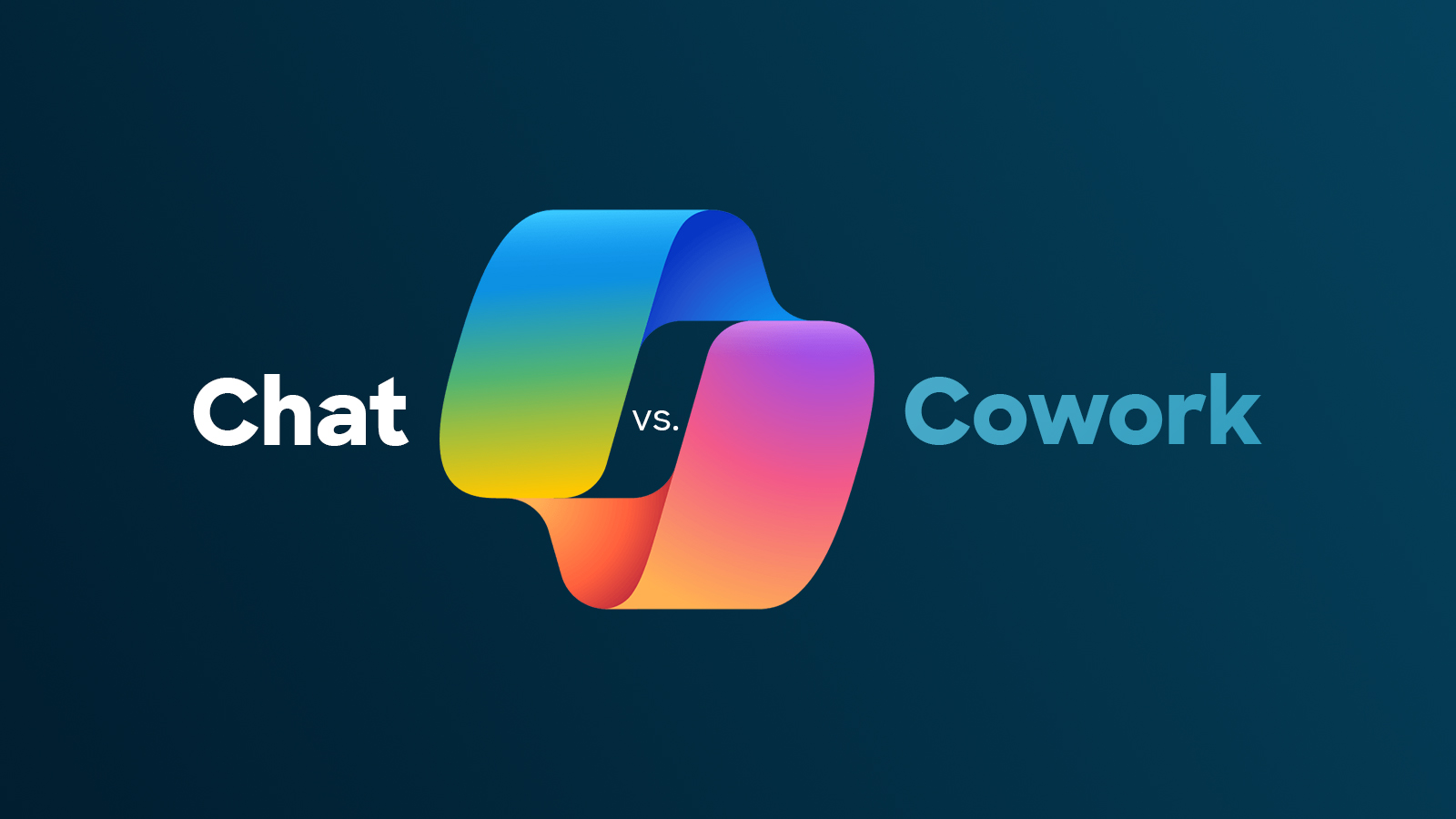
With AI adoption gathering pace and Microsoft releasing new AI tools and capabilities almost weekly, I often find customers coming to seek clarity on what’s new, and what it can do for them. Most recently, it’s been about the difference between Copilot Chat, and the new agent-powered Copilot Cowork.
They can at first seem similar, with both designed to help users work more effectively within the Microsoft ecosystem. But in practice, they have been designed to serve very different purposes.
Understanding those differences is extremely important. It influences productivity, adoption, governance and, importantly, cost. Organisations that get this right will see greater value from their AI investments, while those that don’t may find themselves footing a hefty bill as a result of using the wrong tool for the wrong job.
Copilot Chat helps you think
The simplest way to define Copilot Chat is as a thinking tool.
When I need an answer, a recommendation, an insight or a first draft, Copilot Chat is where I head to first. It can help me research a topic, summarise information, draft an email or sense-check my ideas. It accelerates the thinking process and helps inform my decisions before I carry out the work myself.
Copilot Chat is an extension of the brain. It can reason, analyse, and generate content quickly, but it doesn’t execute. For many employees, this is where the majority of AI value will come from – drafting comms, preparing meeting notes, creating content drafts, analysing documents and conducting research are all great Copilot Chat use cases.
Copilot Cowork helps you delegate
Cowork is different because it moves beyond thinking and into execution. Where Chat helps me decide what to do, Cowork helps me do it.
Instead of generating a response and waiting for me to take an action, Cowork can complete multi-step activities across multiple systems and sources of information. It becomes less like a conversational assistant and more like a delegated worker operating on my behalf.
When I’m deciding whether a task belongs in Cowork, I’ll ask myself four questions:
- Does the task involve several distinct steps?
- Does it require information from multiple applications or business systems?
- Does something need to be created, updated, organised, scheduled, posted or sent?
- Would completing it manually take significantly longer than reviewing the final output?
If you answer yes to most of these questions, then Cowork is probably a better option for you over Copilot Chat.
Some good examples include creating customer briefing packs, producing leadership-ready reports, gathering information from multiple systems, or managing recurring processes that would otherwise consume valuable employee time.
Where organisations are confusing Chat and Cowork
The launch of Cowork was exciting, but it wasn’t a replacement. On quite a few occasions, I’ve heard about organisations using Cowork when Copilot Chat would’ve been perfectly adequate.
I recently spoke to someone who was using Cowork to rewrite emails in a better tone of voice, or to improve some written comms. The outcomes were exactly what they were looking for, but those outcomes would’ve been the same if the work was carried out in Copilot Chat and wouldn’t have incurred any additional cost from Cowork’s consumption model.
This is exactly why AI enablement is so important. Users need to understand not only what the tools can do, but when they should use them.
Why consumption and cost matter
The key distinction between Copilot Chat and Cowork is the consumption models.
Copilot Chat is licenced per user, per month, while Cowork takes a different approach. It’s designed to complete work on their behalf, so usage is consumption-based with costs linked to the tasks being performed. A simple recurring task may consume very little, while a more advanced piece of work involving multiple systems, datasets and processes will consume more.
That consumption model can sound expensive until you consider what you’re actually buying. If you’re using Cowork to rewrite an email that Copilot Chat could handle perfectly well, the additional cost probably isn’t justified. But if you’re using it to analyse months of data, prepare a customer briefing, or complete a multi-step process while you focus elsewhere, the economics quickly change.
For me, the key question isn’t “What does this task cost?”, it’s “What value does this task create?” If spending a few pounds on a Cowork task frees up time for revenue-generating activity, customer engagement or higher-value work, then consumption shouldn’t be viewed as a cost – it should be viewed as an investment in productivity.
AI accountability is the next challenge
As organisations become more comfortable with AI we’re entering a new phase of adoption, and more and more users are getting their hands on these tools.
People and organisations are excited by the possibilities – which is fantastic – but many organisations are yet to establish clear guidance around when to use different AI capabilities and how to govern consumption effectively. With Cowork, ungoverned usage can easily lead to rapidly climbing costs.
This creates a cost problem because while AI curiosity is at an all-time high, AI accountability is at an all-time low. Prompts are typed, buttons are clicked, and before you know it, you’re landed with a huge bill as a result of poor enablement and adoption planning.
This is where partners, IT leaders and internal AI champions all have an important role to play. Copilot Chat and Cowork are not competing tools, they’re complementary – so employees need confidence, understanding and practical guidance if organisations are going to unlock AI’s full potential.